🩸 30+ Tragic Quotes
🎬 Watch Order Guide
💔 Top Sad & Hype Scenes
👥 Similar Anime & Characters
🎯 15-Question Ghoul Quiz
Ken Kaneki’s Awakening Dialogue (Copy & Paste)
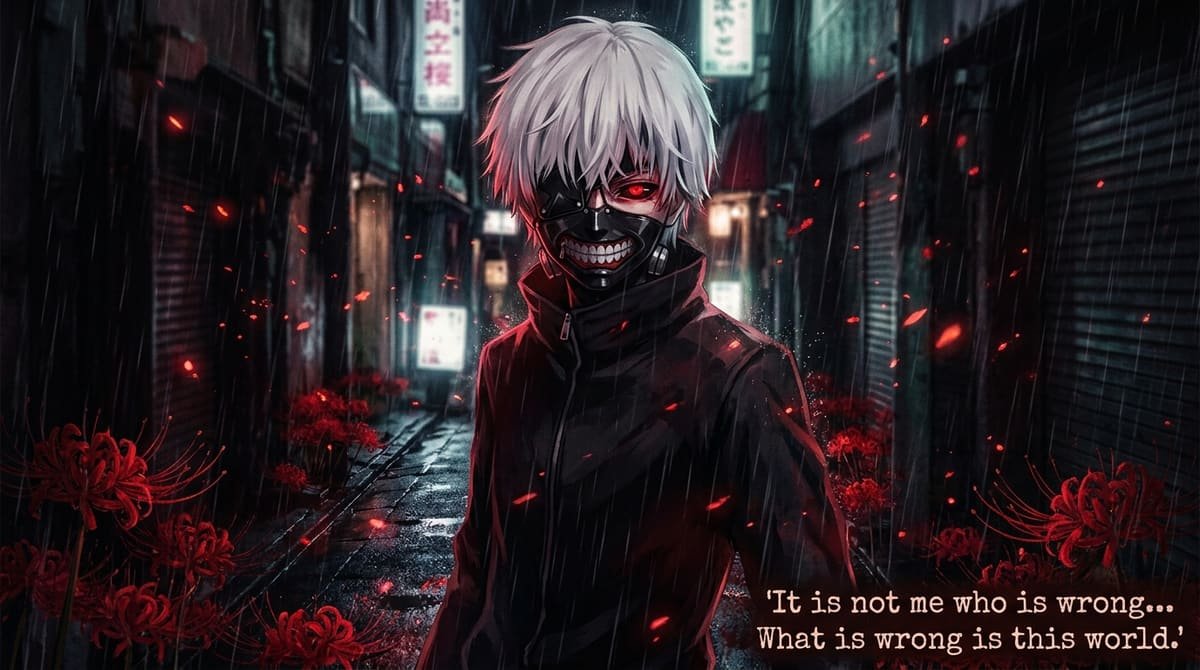
“It is not me who is wrong… What is wrong is this world! I was naive. I believed that being gentle and enduring suffering was the right path. But in a world where the strong devour the weak, choosing only to be hurt just means dying in silence while everything you love is destroyed. I will no longer run away. I am a Ghoul.”
Few characters in anime history have experienced a descent into psychological torment quite like Ken Kaneki from Sui Ishida’s masterpiece, Tokyo Ghoul. Starting as a timid, book-loving college student at Kamii University who believed that “it is better to be hurt than to hurt others,” Kaneki is forcibly thrust into a nocturnal nightmare of cannibalistic predators, moral ambiguity, and relentless identity crisis.
Unlike standard shonen heroes whose suffering merely fuels power-ups and heroic speeches, Kaneki’s journey is an unforgiving psychological deconstruction. His tragedy is rooted in the harsh truth that in a broken world where survival requires monstrosity, pure kindness without strength is merely a death sentence. Below is the definitive compilation of 30+ of the deepest, most agonizing, and philosophically haunting Tokyo Ghoul quotes, paired with character breakdowns, watch order guides, and literary symbolism.
🩸 Psychological Trivia Fact #1: The Red Spider Lily (Higanbana)
Throughout Season 1, the white carnations in Kaneki’s subconscious mental world slowly turn into crimson Red Spider Lilies (Higanbana / 彼岸花). In Japanese folklore, these flowers guide departed souls across the Sanzu River into the afterlife. For Kaneki, they symbolized the death of his human innocence and the bloody birth of his ghoul psyche.
30+ Deepest Ken Kaneki & Tokyo Ghoul Tragedy Quotes
Part 1: The Innocence & Naivety of Black-Haired Kaneki
Before the white hair, the cracked knuckles, and the centipede kagune, Ken Kaneki was a boy who worshipped books and believed his mother’s self-sacrificing philosophy:
1. “I’m not the protagonist of a novel or anything. I’m just a college student who likes to read, like you could find anywhere. But… if, for argument’s sake, you were to write a story with me in the lead role, it would certainly be… a tragedy.”
Context: The opening lines of Chapter 1 / Episode 1. Ishida establishes immediately that Kaneki is not destined for triumph, but for inevitable devastation.
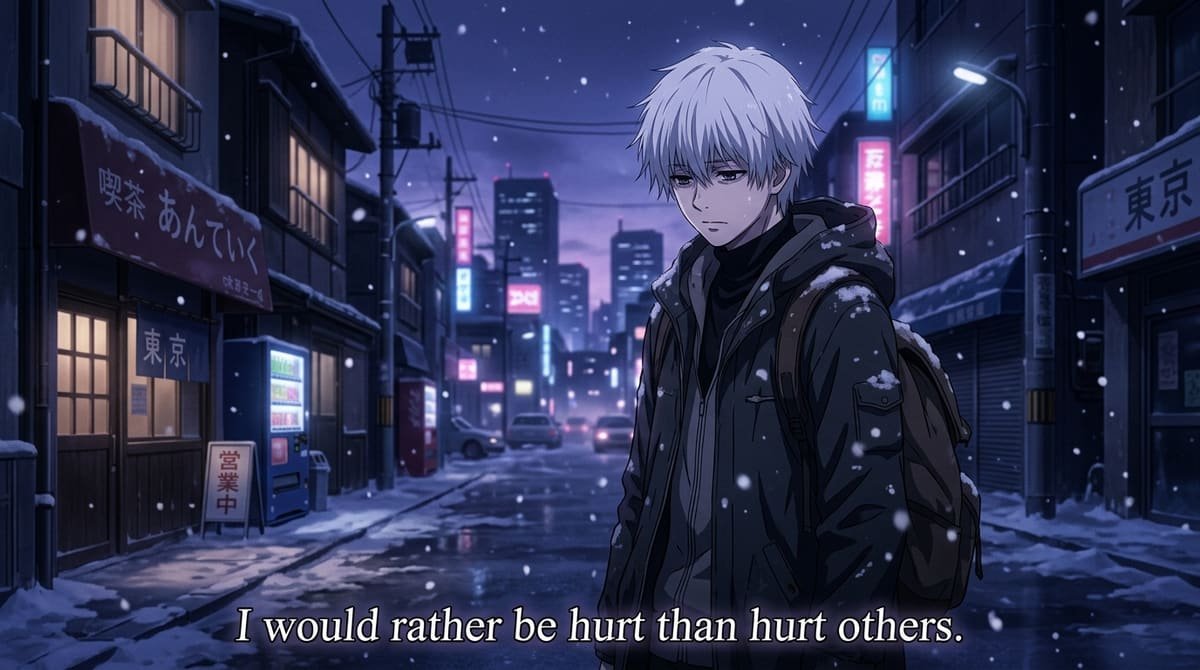
2. “I’d rather be hurt than hurt others. Kind people can be happy with just that.”
Context: Kaneki recites the life motto given to him by his late mother. It was his guiding moral compass, until he realized that passive kindness enabled bullies and predators to destroy everything he cherished.
3. “Why is it that the beautiful things are entwined more deeply with death than with life?”
Context: Kaneki musing on literature and his quiet observation of humanity’s fascination with fleeting, tragic beauty.
4. “Human meat… It looks delicious. Smells delicious. But if I eat it, I will no longer be human!”
Context: The agonizing Episode 2 sequence where Kaneki starves in his apartment, crying on the floor while trying to force down regular food that tastes like rotten oil and bile.
5. “I don’t want to belong anywhere if it means hurting people. But if I don’t choose a side, I will be killed by both.”
Context: Kaneki trapped between the Commission of Counter Ghoul (CCG) and the ghoul underworld of the 20th Ward.
6. “Even if I lose everything, I will fight to protect the small place where I belong.”
Context: Kaneki discovering a fragile surrogate family at Anteiku Coffee Shop with Yoshimura, Touka, and Yomo.
Part 2: Torture, Despair & The White-Haired Awakening
In the torture chamber of Yakumo Oomori (Jason), Kaneki was broken physically and mentally over 10 days until his black hair bleached white from Marie Antoinette syndrome and extreme stress:
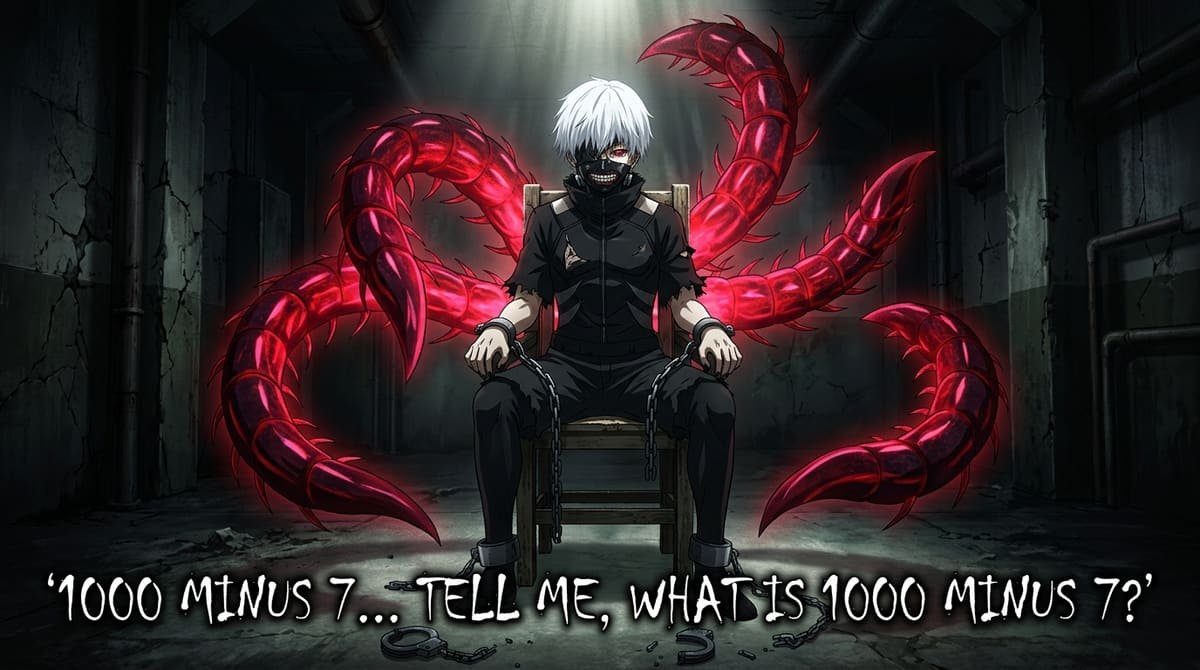
7. “1000 minus 7… Tell me, what is 1000 minus 7? Keep counting. If you pass out, the fun ends.”
Context: Kaneki turning Jason’s own psychological torture mechanism back on him during their climactic battle in the Season 1 finale.
8. “It’s not me who is wrong. What is wrong is this world! In this world, the strong devour the weak. Who are the strong? I am.”
Context: Kaneki finally devouring Rize Kamishiro’s hallucination in his subconscious and embracing his ghoul predatory nature.
9. “All the disadvantage in this world is due to a person’s lack of ability.”
Context: A cold, brutal axiom Kaneki adopts from Rize and Jason. If you are powerless, your suffering is merely the consequence of your weakness.
10. “You think something like that would hurt, after all I’ve been through?”
Context: Kaneki effortlessly dodging Jason’s attacks with dead, unblinking eyes, showing complete detachment from physical pain.
11. “I am a ghoul. I am neither human nor monster, yet I am both. And because I stand between both worlds, I must bear the weight of their sins.”
Context: Kaneki accepting the curse of his hybrid existence.
12. “Never trust anyone too much. Remember, the devil was once an angel.”
Context: A reflection on the betrayal of Rize on their first date, which irrevocably ruined his human life.
13. “Pain is my friend, my ally. It reminds me that I’m still alive while everything around me is rotting away.”
Context: Kaneki’s internalization of trauma as armor against further emotional breakdown.
Part 3: Centipede Kakuja, Cold Detachment & Sasaki Haise
14. “I have to protect everyone… Even if it means tearing off my own limbs, even if it means becoming a monster that everyone hates.”
Context: Kaneki during his Centipede (Mukade) Kakuja transformation, cannibalizing other ghouls to gain power to defend Anteiku.
15. “Don’t erase me! I’m begging you… If you regain your memories, Kaneki, I will disappear! I don’t want to die!”
Context: Haise Sasaki pleading in his inner subconscious in Tokyo Ghoul:re as his suppressed Kaneki persona begins to wake up.
16. “Why do I have to save people who don’t even want to be saved? Why was I chosen to bleed for everyone else?”
Context: The Black Reaper Kaneki in :re experiencing severe burnout and existential exhaustion.
17. “I wanted to die in a stylish way… fighting for someone else so that I would be remembered as a hero.”
Context: Kaneki confessing his underlying suicidal ideation during his climactic fight against Kisho Arima.
18. “I am the One-Eyed King. If humans and ghouls cannot understand each other through words, we will force a conversation through blood and unity.”
Context: Kaneki founding Goat, the revolutionary organization aimed at ending the perpetual war.
Part 4: Iconic Quotes from Other Tokyo Ghoul Characters
19. Touka Kirishima: “What the hell do you know about being a ghoul?! You were born human, you had a normal life! We have to live every single day terrified of being hunted down just for wanting to exist!”
Context: Touka beating Kaneki in the alley after he complains about losing his humanity.
20. Yoshimura (The Non-Killing Owl): “We are all sinners. We take lives to sustain our own. But that doesn’t mean we cannot choose kindness in the little time we have left.”
Context: Yoshimura offering coffee and shelter to Kaneki at Anteiku.
21. Rize Kamishiro: “There’s no such thing as fate. It’s simply a combination of one circumstance and the next. And who makes those circumstances? You do.”
Context: Rize taunting Kaneki’s victim mentality.
22. Kisho Arima (The CCG Reaper): “I was always envying… I could only destroy. I wanted to leave something behind. Kaneki… you are the one who will kill the God of Death.”
Context: Arima’s final words to Kaneki before his death in Cochlea.
23. Hideyoshi Nagachika: “Let’s go home, Kaneki. I’ve known all along. It doesn’t matter what you’ve become… you’re still my best friend.”
Context: The heartbreaking confrontation in the sewer during the Raid on Anteiku.
24. Juzo Suzuya: “Why should I apologize for being a monster? Has anyone ever apologized for turning me into one?”
Context: Juzo reflecting on his childhood torture under Big Madam.
25. Shuu Tsukiyama (The Gourmet): “Ah, Kaneki! Your scent… it is a symphony of tragedy and perfection! To taste you would be to experience heaven and hell simultaneously!”
Context: Tsukiyama’s obsessive, theatrical fixation on Kaneki’s unique half-ghoul flesh.
26. Kureo Mado: “When you’re in front of the enemy, even if your hands are trembling… fight! That’s what it means to be a professional investigator.”
Context: Mado lecturing Amon on the ruthless reality of CCG ghoul hunting.
27. Koutarou Amon: “This world is wrong. It is warped. But if I don’t believe that justice exists, how am I supposed to protect anyone?”
Context: Amon’s existential crisis upon realizing ghouls have families and emotions.
28. Renji Yomo: “We don’t fight because we want to win. We fight because if we stop moving, the grief will crush us.”
Context: Yomo mentoring Kaneki on martial arts and emotional endurance.
29. Uta (No Face): “We need to have a mask that we never take off. Because the moment you show your real face, people will find a way to destroy it.”
Context: Uta crafting Kaneki’s iconic ghoulish leather zipper mask at HySy ArtMask Studio.
30. Ken Kaneki (Final Monologue): “If you were to write a story with me in the lead role, it would indeed be a tragedy. But… I was happy. I met wonderful people. The world isn’t wrong. It just is. And even if I had to suffer all over again, I would still choose this life.”
Context: The serene conclusion of Tokyo Ghoul:re, closing Kaneki’s full circle of self-acceptance and healing.
📖 Literary DNA: Franz Kafka & Hermann Hesse
Sui Ishida heavily grounded Tokyo Ghoul in Western existentialist literature. Kaneki reading Franz Kafka’s The Metamorphosis parallels Gregor Samsa waking up transformed into a monstrous vermin rejected by his family. Furthermore, Hermann Hesse’s Demian provides the central philosophical metaphor of the series: “The bird fights its way out of the egg. The egg is the world. Who would be born must first destroy a world.”
Chronological & Canonical Tokyo Ghoul Watch Order
One of the biggest issues new anime fans face is the confusing release schedule and canon divergence of the Tokyo Ghoul anime adaptations by Studio Pierrot. Here is the exact order to watch the series:
| Release Order | Season / Title | Episodes | Canon Status & Notes |
|---|---|---|---|
| 1 | Tokyo Ghoul (Season 1) | 12 Episodes | Direct adaptation of Manga Ch. 1–66. Masterpiece pacing. |
| 2 | Tokyo Ghoul: JACK & PINTO (OVAs) | 2 OVAs | Prequel stories exploring young Arima Kisho & Tsukiyama. |
| 3 | Tokyo Ghoul √A (Season 2) | 12 Episodes | Anime-Original Route: Kaneki joins Aogiri Tree (Diverges from manga). |
| 4 | Tokyo Ghoul:re (Season 3, Part 1) | 12 Episodes | Follows Haise Sasaki & the Quinx Squad (Adapts Manga Canon). |
| 5 | Tokyo Ghoul:re (Season 3, Part 2) | 12 Episodes | Final War, Dragon Kaneki, and series conclusion. |
⚠️ Essential Reader Advice: While Season 1 is one of the greatest anime adaptations ever made, Season 2 (√A) diverged into an alternative storyline where Kaneki joined Aogiri Tree instead of creating his own anti-Aogiri faction. If you want the complete, uncensored psychological experience with full character backstories, reading Sui Ishida’s original Tokyo Ghoul and Tokyo Ghoul:re manga is highly recommended alongside watching the anime.
Top 5 Most Devastating & Hype Scenes in Tokyo Ghoul
1. The Season 1 Finale: 1000-7 & Awakening (Episode 12)
Widely regarded as one of the single greatest season finales in anime history. The brilliant voice acting of Natsuki Hanae, the visual metaphor of the red spider lilies blooming, the brutal knuckle-cracking sound effect, and the explosive drop of TK from Ling Tosite Sigure’s “Unravel” created an unforgettable cultural moment.
2. The Acoustic “Unravel” Snow Walk with Hide (√A Finale)
Regardless of opinions on √A’s plot changes, the final 10 minutes featuring an acoustic, stripped-back rendition of Unravel while Kaneki carries his best friend Hide’s lifeless body wrapped in a sheet across the burning battlefield directly toward the CCG Reaper Kisho Arima is pure cinematic melancholy.
3. The Centipede Kakuja Rampage vs Shinohara
When Kaneki’s mind shatters under the weight of cannibalism, his Kagune manifests as twin centipede tails that curl around his torso. His psychotic, slurred speech reciting multiplication tables while ripping apart CCG special investigators demonstrated the horrifying physical cost of power.
4. The Black Reaper Awakening & Arima’s Defeat (Tokyo Ghoul:re)
When Haise Sasaki accepts all his past identities — the timid boy, the white-haired monster, and the CCG mentor — he awakens with jet-black hair as the Black Reaper. His duel in Cochlea against his father-figure Kisho Arima represents the pinnacle of martial and emotional tragedy.
5. Kaneki Realizing He Can Never Eat Regular Food (Episode 2)
The quiet tragedy of Kaneki in his dark kitchen, frantically opening food packages — burgers, bread, stew — only to vomit everything into the sink. The realization that he can never again share a normal meal with his best friend Hide is more devastating than any physical wound.
Similar Psychological Characters & Anime Recommendations
If you love the dark existential tragedy, dual-nature struggle, and psychological depth of Ken Kaneki and Tokyo Ghoul, here are 5 must-watch anime series that explore identical themes:
| Anime Title | Character Parallel | Why Tokyo Ghoul Fans Love It |
|---|---|---|
| Parasyte: The Maxim | Shinichi Izumi & Migi | An ordinary student merges with an alien predator in his right hand. Explores human hypocrisy and losing emotional humanity. |
| Attack on Titan | Eren Yeager | A boy sworn to eradicate monsters ends up turning into the ultimate titan monster to secure freedom for his people. |
| Berserk (1997 / Manga) | Guts (The Black Swordsman) | The apex archetype of enduring unimaginable trauma, betrayal, and demonic suffering while refusing to kneel to fate. |
| Dororo | Hyakkimaru | A boy born without limbs, eyes, skin, or voice due to his father’s demon pact, hunting 12 demons to reclaim his stolen body. |
| Chainsaw Man | Denji & Pochita | A dirt-poor boy merging with a devil chainsaw heart, exploited by authority figures while desperately yearning for basic human dignity. |
🩸 15 Ultimate Tokyo Ghoul Trivia Questions
Test your deep knowledge of Kagune types, CCG Investigators, and Kaneki’s tragedy!
1. What organ was transplanted into Ken Kaneki to save his life after the steel beam accident?
2. What type of Kagune did Ken Kaneki inherit from Rize?
3. What is the name of the peaceful coffee shop in the 20th Ward that sheltered ghouls?
4. Why did Ken Kaneki’s hair turn from black to white during his 10 days of torture?
5. What was the name of the CCG’s undisputed strongest Special Class Investigator, known as the “White Reaper”?
6. What is the identity of the One-Eyed Owl (Takatsuki Sen)?
7. What weapon used by CCG investigators is forged directly from harvested Ghoul Kakuhou organs?
8. What is the title of the legendary Season 1 opening theme song performed by TK from Ling Tosite Sigure?
9. What identity does Kaneki live under as a CCG Associate Special Class investigator in Tokyo Ghoul:re?
10. What human food can ghouls consume without becoming sick?
11. Who is the mask maker who owns HySy ArtMask Studio and creates Kaneki’s leather mask?
12. What was the name of the secret organization of clowns who orchestrated the steel beam accident on Kaneki and Rize?
13. What occurs when a ghoul repeatedly cannibalizes other ghouls?
14. What university did Ken Kaneki and Hideyoshi Nagachika attend?
15. What revolutionary organization did Ken Kaneki create to bridge peace between humans and ghouls?
Frequently Asked Questions (FAQ) About Ken Kaneki
Q: Why is Ken Kaneki considered one of the most tragic anime protagonists?
A: Because Kaneki never chose violence or power for selfish ambition. Every transformation he underwent was forced upon him by horrific trauma, torture, and a desperate desire to protect the few people he loved, only to watch them suffer regardless.
Q: Is Tokyo Ghoul worth watching in 2026?
A: Absolutely. Season 1 is a benchmark for psychological dark fantasy anime with unmatched soundtrack design and voice acting. To get the full uncompressed story, pairing the anime with Sui Ishida’s manga provides one of the richest literary experiences in modern fiction.
Q: What is the meaning behind the knuckle-cracking habit?
A: Kaneki inherited the knuckle-cracking tic from his torturer, Yakumo Oomori (Jason), who originally copied it from the CCG investigator who tortured him in Cochlea. It is a psychological symbol of the intergenerational cycle of abuse and trauma.
Final Thoughts: Embracing Reality Through Tragedy
Ken Kaneki’s journey resonates because it mirrors our own battles with identity, trauma, and emotional growth. We all start out believing that pure kindness will shield us from the world. But when life deals us heartbreak, grief, and betrayal, we are forced to evolve.
Kaneki teaches us that while the world may be harsh, retreating into passive despair is not the answer. True strength is not about remaining unblemished — it is about walking through hell, accepting your scars, and still fighting for the people who make reality worth living.

Written by Purosotam
Author & Founder
Hey there! I’m Purosotam. I’ve been writing, gaming, and exploring anime and web series for a long time while currently pursuing my higher education. I’m fascinated by psychological storytelling, complex characters, and the real-world philosophy hidden behind great dialogue. When I’m not writing or exploring new virtual worlds, you’ll find me at the gym leveling up in real life!
💬 What the Anime Community on Reddit Thinks (r/TokyoGhoul)
Across the global anime community on r/TokyoGhoul, thousands of readers and philosophy enthusiasts have debated the real-world meaning behind these monologues. Here is the embedded community thread and the top-voted fan perspectives:
u/OneEyedKing24
⬆️ 2.5k upvotes
“Kaneki’s transition from ‘Rather than a person who hurts others, become the person getting hurt’ to realizing that extreme self-sacrifice actually abandons the people who love you is one of the deepest psychological character studies in seinen manga.”
u/Centipede1000Minus7
⬆️ 1.4k upvotes
“Sui Ishida’s tarot card symbolism and literary references to Franz Kafka’s The Metamorphosis and Hermann Hesse’s Demian elevate Kaneki’s internal monologues into pure literature.”
u/ToukaKirishima
⬆️ 880 upvotes
“When Kaneki finally says ‘The world isn’t wrong. It just is’ at the end of Tokyo Ghoul:re, he finally lets go of his victimhood and finds peace.”
Kaneki’s realization that “being the one who gets hurt” was actually just a selfish way to avoid conflict and abandon the people who needed him is peak character writing. Amazing post and loved the 15-question Tokyo Ghoul quiz!
Thanks, Sora! Sui Ishida’s psychological depth in Tokyo Ghoul is unmatched.