Osamu Dazai’s “Stop Pitying Yourself” & Odasaku’s Wish
“Stop pitying yourself. If you pity yourself, life becomes an endless nightmare. Justice is a weapon. It can be used to cause harm, but it cannot protect or save others. If being good or evil makes no difference to you, then choose to be on the side that saves people. At least that way, your life will be a little more beautiful.”
Among the most enigmatic, witty, and deeply philosophical characters in modern anime stands Osamu Dazai from Kafka Asagiri’s Bungo Stray Dogs (Bungō Sutorei Doggusu). Cloaked in bandages, sharp trench coats, and an outwardly eccentric demeanor, Dazai harbors a brilliant analytical mind and a profound existential emptiness born from his brutal past as the Port Mafia’s youngest executive.
Inspired by the real-life literary master who penned No Longer Human (Ningen Shikkaku), Dazai’s dialogue dissects the fragility of morality, the poisonous nature of self-pity, and the struggle to find purpose in an indifferent universe. Guided by the dying wish of his closest friend, Oda Sakunosuke (Odasaku), Dazai transitioned from bloodshed to the Armed Detective Agency — proving that even a broken soul can choose to be on the side that saves people. Below is the definitive, human-level analytical breakdown of 35+ of Osamu Dazai’s most profound quotes, Japanese transcripts, and interactive trivia.
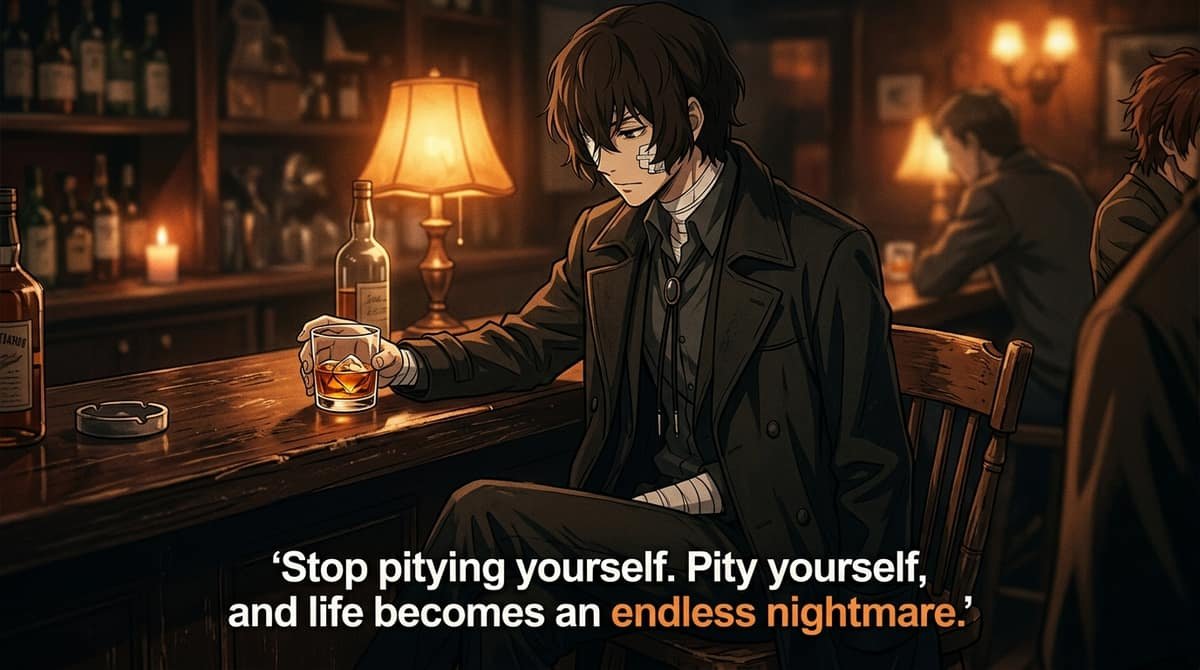
🍸 Lore Fact #1: Bar Lupin & The Buraiha Trio
The subterranean bar where Dazai, Oda Sakunosuke, and Ango Sakaguchi drink together is based on the real-life Bar Lupin in Ginza, Tokyo, which opened in 1928 and was a famous gathering spot for post-war Japanese writers of the Buraiha (Decadent School) literary movement. The famous photograph of Dazai resting his foot on a bar stool in the anime is a frame-by-frame tribute to the iconic real-life photograph of author Osamu Dazai taken by Tadahiko Hayashi in 1946.
Japanese Dialogue & Romaji: “Jibun o awaremu na”
🇯🇵 Japanese Kanji / Hiragana (Original Dialogue):
「自分を憐れむな。自分を憐れめば、人生は終わりなき悪夢だ。正義は武器だ。それは人を傷つけることはできても、人を守ることも救うこともできない。人を救う側になれ。どちらも同じなら、いい人間になれ。」
🗣️ Romaji Pronunciation:
“Jibun o awaremu na. Jibun o awaremeba, jinsei wa owari no nai akumu da. Seigi wa buki da. Sore wa hito o kizutsukeru koto wa dekitemo, hito o mamoru koto mo sukuu koto mo dekinai. Hito o sukuu gawa ni nare. Dochira mo onaji nara, ii ningen ni nare.”
🌐 Official English Translation:
“Stop pitying yourself. If you pity yourself, life becomes an endless nightmare. Justice is a weapon. It can be used to cause harm, but it cannot protect or save others. Be on the side that saves people. If both are the same to you, become a good human.”
35+ Deep Osamu Dazai Quotes (With Human Psychological Explanations)
Part 1: Self-Pity, Strength & Mentoring Atsushi
1. “Stop pitying yourself. Pity yourself, and life becomes an endless nightmare.”
The Human Breakdown: Dazai delivers this sharp rebuke to Atsushi Nakajima when Atsushi falls into a spiral of worthlessness about his orphanage trauma. In cognitive therapy, self-pity is recognized as one of the most paralyzing mental traps: it creates the illusion of comfort while silently stripping away your agency. Dazai understands that acknowledging past pain is healthy, but indulging in self-pity turns you into an eternal victim who refuses to stand up.
2. “Atsushi-kun, people need to be told they are worthy of being alive by someone else to keep on living.”
The Human Breakdown: The psychological core of human attachment. No one can survive purely on internal validation alone. Human beings require at least one mirror in the world—a friend, mentor, or partner—to affirm that their existence has meaning.
3. “Do not fear making mistakes. The only mistake you can truly make is convincing yourself that you have no right to try.”
The Human Breakdown: Overcoming perfectionist paralysis. In high-stakes situations, people often freeze because they fear looking foolish, forgetting that growth only happens through clumsy attempts.
4. “You cannot measure a person’s worth by how many times they fall; you measure it by how stubbornly they pull themselves back up from the dirt.”
The Human Breakdown: Resiliency coaching. Dazai sees past Atsushi’s initial timidity because he recognizes the young man’s ferocious refusal to let others suffer.
5. “Pain is the currency we pay for wisdom. But if you keep holding onto the receipt, you will never enjoy what you bought.”
The Human Breakdown: Moving beyond past trauma. Learn the lesson from your heartbreak or failure, but do not let the grievance define your everyday identity.
Part 2: The Port Mafia, The Dark Era & Odasaku’s Legacy
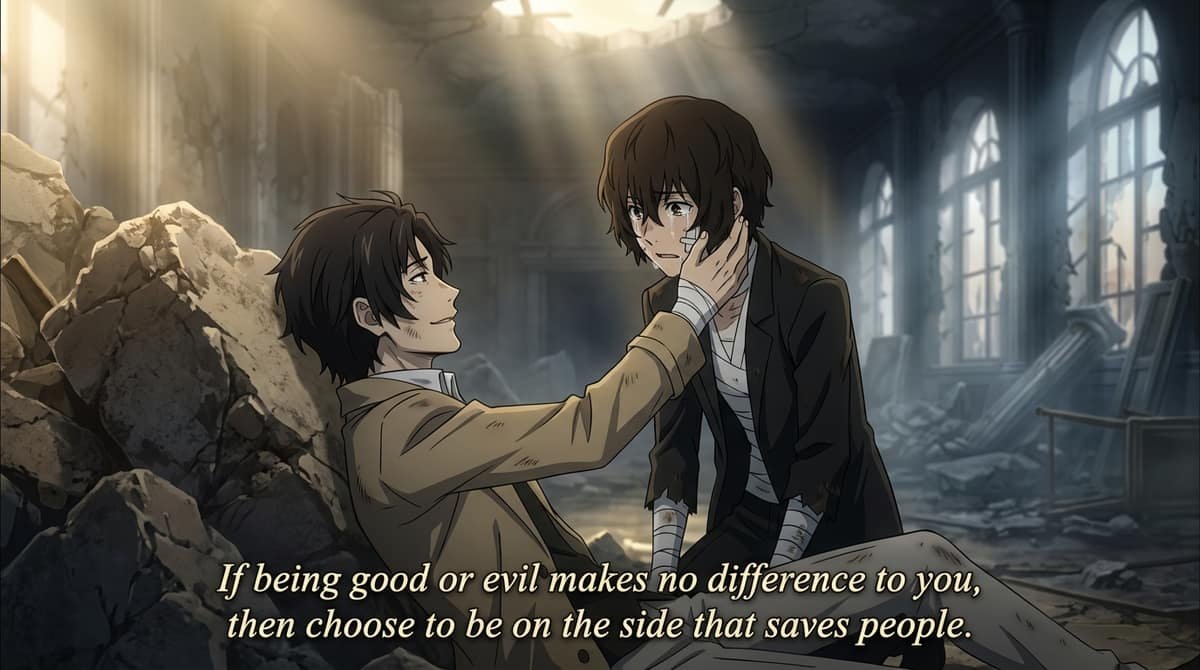
6. “If being good or evil makes no difference to you, then choose to be on the side that saves people. At least that way, your life will be a little more beautiful.” — Oda Sakunosuke
The Human Breakdown: The Dark Era finale (Season 2 Episode 4). As Odasaku lies dying in the ruins of the Gide battle, he gives Dazai the compass he lacked his entire life. Dazai lived in pure nihilism where murder and kindness carried identical weight. Odasaku did not appeal to morality; he appealed to aesthetics. If existence is meaningless, choosing compassion is simply a more elegant way to spend your brief time alive.
7. “I thought that if I placed myself close to death, bloodshed, and raw human violence, I would be able to see the true nature of humanity… But all I found was emptiness.”
The Human Breakdown: Dazai reflecting on his time as the Port Mafia’s demon prodigy. Evil and cruelty are not profound; they are mundane, primitive, and intellectually barren.
8. “Odasaku… you were the only one who truly understood me. And that is why you knew exactly how to save me.”
The Human Breakdown: The rare, unfiltered emotional bond between two lonely men. Odasaku never judged Dazai’s darkness; he simply offered a gentle hand toward the light.
9. “A man who has never tasted defeat cannot truly appreciate the weight of victory.”
The Human Breakdown: Dazai’s mentorship of Ryunosuke Akutagawa. Dazai intentionally withheld praise from Akutagawa to forge him into a survivor who could adapt when his raw power failed.
10. “The underworld is dark and suffocating. But once your eyes adjust to the darkness, stepping into the sun hurts like hell.”
The Human Breakdown: The psychological difficulty of leaving toxic environments or destructive habits. Rehabilitation is physically and emotionally painful before it feels liberating.
Part 3: Justice, Morality & Human Nature
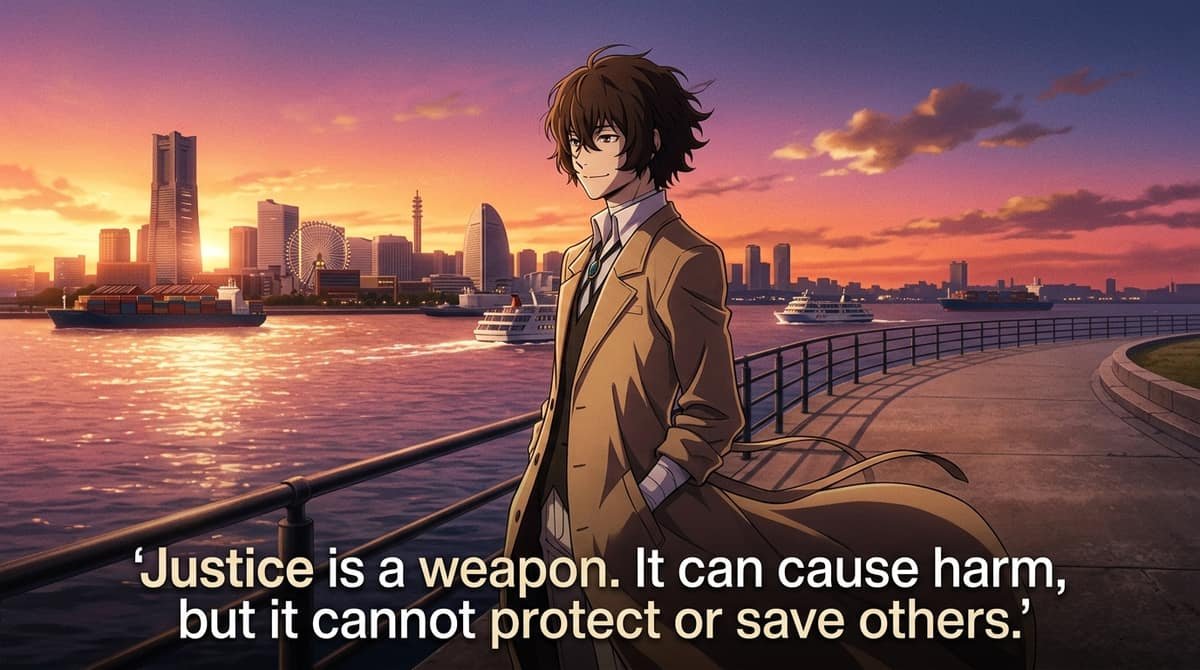
11. “Justice is a weapon. It can be used to cause harm, but it cannot protect or save others.”
The Human Breakdown: In human history, most atrocities were committed under the banner of “justice” and ideological righteousness. When people believe they possess moral superiority, they justify cruelty against their enemies. Dazai understands that only compassion and mercy, not weaponized justice, can actually heal a broken world.
12. “Everything worth wanting is lost the moment I obtain it. Nothing I desire is worth prolonging a life of suffering.”
The Human Breakdown: A direct echo of the literary Osamu Dazai’s *No Longer Human*. Anhedonia and existential dread: when achieving a goal immediately dissolves the joy you anticipated.
13. “Human beings are terrifying precisely because they can smile while holding a poisoned dagger behind their backs.”
The Human Breakdown: Machiavellian social dynamics. The most dangerous opponents are never the loud aggressors, but the polite hypocrites who blend seamlessly into social circles.
14. “To overcome an enemy who possesses godlike intellect, you do not try to outsmart them. You make a move so illogical that their calculations collapse.”
The Human Breakdown: Dazai’s psychological warfare against Fyodor Dostoevsky in the Meursault prison arc.
15. “A mask worn long enough becomes your actual skin. Be careful which face you choose to show the world.”
The Human Breakdown: Jungian persona theory: if you constantly pretend to be cheerful, cynical, or indifferent, your subconscious will eventually conform to the performance.
Part 4: Armed Detective Agency, Wit & Existential Hope
16. “Kunikida-kun, life is not a schedule book that you can organize with tidy bullet points. The most beautiful moments are always the ones that ruin your itinerary.”
The Human Breakdown: Dazai playfully dismantling Doppo Kunikida’s rigid idealism. Embracing life’s inherent chaos and serendipity.
17. “Having a death wish is easy. Having the courage to wake up, face a mundane Tuesday, and be kind to someone is true bravery.”
The Human Breakdown: The quiet maturity beneath Dazai’s eccentric suicidal jokes. Living through the boring, difficult days requires ten times more stamina than giving up.
18. “A real strategist does not win by crushing the opponent. They win by making the opponent realize that fighting was pointless from the start.”
The Human Breakdown: Sun Tzu’s *Art of War* applied to detective strategy.
19. “Chuuya, you and I make a terrible pair. But whenever we stand together, the entire underworld trembles.”
The Human Breakdown: The iconic *Double Black (Soukoku)* partnership between Dazai and Chuuya Nakahara: absolute tactical intellect paired with raw gravitational power.
20. “Do not pity the dead. Pity the living who must carry the weight of their absence.”
The Human Breakdown: Dazai visiting Odasaku’s grave on the cliff overlooking Yokohama.
21. “If you can’t find a reason to live for yourself, live for a cup of tea, a good book, or the promise of seeing tomorrow’s sunrise.”
The Human Breakdown: Micro-meaning in existential psychology: when grand purposes fail, anchor yourself to small, sensory pleasures.
22. “The Armed Detective Agency is not just a workplace. It is a home for strays who have nowhere else in this city to go.”
The Human Breakdown: Finding chosen family among fellow outcasts.
23. “A genius who relies solely on intellect will always be blindsided by someone driven by pure, irrational love.”
The Human Breakdown: Acknowledging the unpredictable power of human emotional devotion.
24. “You cannot erase the blood on your hands by washing them in tears. You erase it by reaching out to pull someone else from the fire.”
The Human Breakdown: Active redemption through positive action rather than passive guilt.
25. “A lie is most believable when whispered with a gentle smile.”
The Human Breakdown: Deception analysis.
26. “Do not trust words. Words are cheap. Watch a person’s feet: where they walk when no one is watching tells you everything.”
The Human Breakdown: Behavioral profiling.
27. “An intelligent person appears eccentric to ordinary people because they do not waste energy pretending to fit into foolish games.”
The Human Breakdown: Non-conformity as a filter.
28. “Solitude is sweet only when you know you can return to the warmth of friends whenever you choose.”
The Human Breakdown: The difference between voluntary solitude and enforced isolation.
29. “The mind is a labyrinth. If you spend too much time wandering through your own regrets, you will forget the way back to the entrance.”
The Human Breakdown: Breaking rumination loops.
30. “If you want to understand a criminal, do not study their crime. Study what they felt when they believed they were justified.”
The Human Breakdown: Deep criminological empathy.
31. “A leader who sacrifices his subordinates for the sake of the organization has already failed as a leader.”
The Human Breakdown: Contrasting Mori Ogai’s cold utilitarian leadership with Fukuzawa’s protective honor.
32. “To live is to be flawed. Perfection is for statues and tombstones.”
The Human Breakdown: Embracing human imperfection (Wabi-sabi).
33. “A toast to the stray dogs! May our wandering lead us to something worth protecting.”
The Human Breakdown: The foundational spirit of Bungo Stray Dogs.
34. “The world is absurd. That is why laughing at the absurdity is the ultimate act of rebellion.”
The Human Breakdown: Albert Camus’ Myth of Sisyphus reflected in Dazai’s humor.
35. “As long as you are alive, your story is still being written. Do not put a period where life intended a comma.”
The Human Breakdown: Dazai’s ultimate message of enduring hope for anyone struggling with dark thoughts.
📖 Literary History: The Real-Life Osamu Dazai
The character in the anime is a direct tribute to author Osamu Dazai (1909–1948), one of 20th-century Japan’s most celebrated novelists. His semi-autobiographical masterpiece No Longer Human (Ningen Shikkaku) is the second best-selling novel in Japanese history behind Natsume Soseki’s Kokoro. His ability in the anime, No Longer Human, nullifies any supernatural power upon physical touch — reflecting the novel’s protagonist who felt entirely detached from the “abilities” and conventions of ordinary human society.
The Psychology of “No Longer Human”: Turning Darkness Into Purpose
Why do millions of fans worldwide relate so deeply to Osamu Dazai? Here are the core psychological takeaways:
1. Humor as an Emotional Shock Absorber: Dazai masks his profound existential pain with witty banter, theatrical antics, and teasing. In psychology, humor is classified as a mature defense mechanism that allows high-functioning individuals to endure intense internal turmoil without collapsing.
2. The Power of a Single Anchor: Dazai’s entire moral trajectory pivoted on four words from Odasaku: “Be on the side that saves people.” When you feel like your own life lacks meaning, dedicating your efforts to protecting others gives you a concrete reason to get out of bed.
3. Choosing Active Redemption: Dazai never excuses his violent past in the Port Mafia. Instead, he accepts accountability and channels his dark understanding of human nature to outmaneuver terrorists and protect the innocent at the Armed Detective Agency.
🥀 15 Ultimate Osamu Dazai & BSD Trivia Questions
Test your mastery of the Dark Era, Bar Lupin, Double Black (Soukoku), and Bungo Stray Dogs lore!
1. What is the name of Osamu Dazai’s supernatural ability that nullifies any ability upon physical contact?
2. Who was Dazai’s closest friend in the Port Mafia whose dying wish inspired him to join the Armed Detective Agency?
3. What is the legendary combat duo name given to the partnership of Osamu Dazai and Chuuya Nakahara?
4. What is the name of the vintage subterranean bar where Dazai, Odasaku, and Ango met to drink whiskey?
5. What idealist detective partner of Dazai carries an “Ideals” notebook and is constantly pranked by him?
6. What is the name of the were-tiger boy rescued by Dazai from the river in Episode 1?
7. Who is the president and martial arts founder of the Armed Detective Agency who accepted Dazai?
8. What Russian mastermind and leader of the “Rats in the House of the Dead” is Dazai’s intellectual equal?
9. What young Port Mafia subordinate was ruthlessly trained by Dazai and desperately seeks his acknowledgment?
10. What is the name of the underground organization of gift-users that controls the port city of Yokohama?
11. What is the name of the genius detective in the Agency who solves cases in seconds without an actual supernatural ability?
12. At what young age did Osamu Dazai become an executive in the Port Mafia?
13. What is the name of Chuuya Nakahara’s god-tier gravity manipulation ability?
14. What anime studio produced the Bungo Stray Dogs anime adaptation and movies?
15. What is the name of the magical blank novel page capable of rewriting reality in Yokohama?
Frequently Asked Questions (FAQ) About Osamu Dazai
Q: Why is Dazai covered in bandages in Bungo Stray Dogs?
A: In addition to treating injuries from his reckless suicidal attempts, Dazai’s bandages serve as a psychological symbol of his fragmented humanity and the emotional wounds he carries from his Dark Era past in the Port Mafia.
Q: Why did Dazai leave the Port Mafia?
A: Dazai left the Port Mafia to honor the dying wish of his best friend, Oda Sakunosuke (Odasaku), who told him that if living in light or darkness makes no difference to him, he should choose to be on the side that saves people and protects orphans.
Q: What does “No Longer Human” symbolize?
A: In both Kafka Asagiri’s anime and author Osamu Dazai’s original 1948 novel, *No Longer Human* represents feeling alienated from standard human emotions and social norms. In the anime, this manifests as an ability that nullifies all other powers, emphasizing Dazai’s disconnection from everyone around him.
Final Thoughts: A Toast to the Wandering Strays
Osamu Dazai’s journey in Bungo Stray Dogs resonates because it proves that you do not need to be a flawless saint to do good in the world.
Even if you feel lost, damaged, or burdened by past mistakes, you can make the conscious choice today to put down the weapon, stop indulging in self-pity, and become a person who protects others. In a chaotic universe, choosing to be kind is the ultimate power.
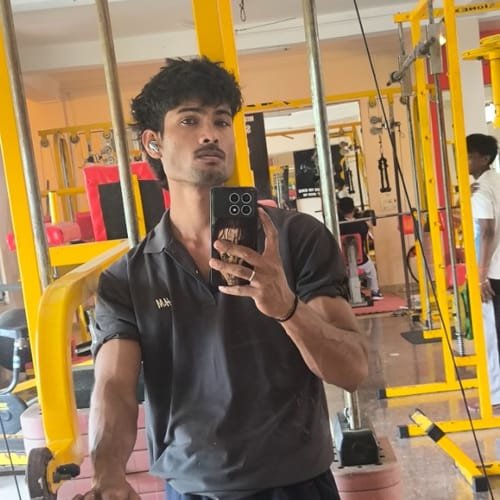
Written by Purosotam
Author & FounderHey there! I’m Purosotam. I’ve been writing, gaming, and exploring anime and web series for a long time while currently pursuing my higher education. I’m fascinated by psychological storytelling, complex characters, and the real-world philosophy hidden behind great dialogue. When I’m not writing or exploring new virtual worlds, you’ll find me at the gym leveling up in real life!