Ayanokoji’s “All People Are Tools” Speech (Copy & Paste)
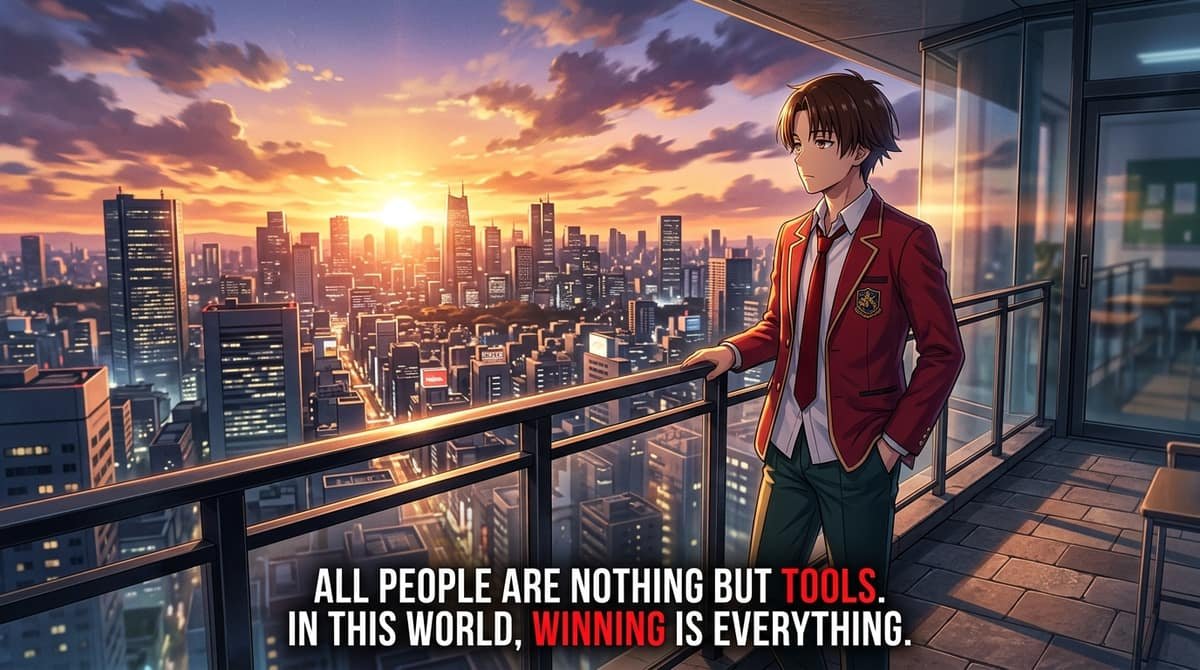
“I have never once thought of you as an ally. Not you, not Kushida, not Hirata. All people are nothing but tools. It doesn’t matter how it gets done. It doesn’t matter what needs to be sacrificed. In this world, winning is everything. As long as I win in the end… that is all that matters.”
In the cutthroat landscape of psychological anime, most protagonists rely on flashy superpowers or dramatic speeches about friendship and justice. But in Shōgo Kinugasa’s Classroom of the Elite (Youkoso Jitsuryoku Shijou Shugi no Kyoushitsu e), Ayanokoji Kiyotaka operates entirely in the shadows — a high-functioning mastermind who treats human emotions, social hierarchies, and personal relationships like pieces on a chessboard.
Reared in the experimental subterranean facility known as the White Room, Ayanokoji was stripped of ordinary emotional vulnerability. When he famously revealed his internal monologue — “All people are nothing but tools” — he redefined modern anime pragmatism. Below is the definitive, human-level analytical breakdown of 35+ of Ayanokoji’s most chilling quotes, Japanese transcripts, dark psychology principles, and trivia challenges.
🏫 Lore Fact #1: The 50-Point Deliberate Deception
During the entrance examinations for the Tokyo Metropolitan Advanced Nurturing High School, Ayanokoji scored precisely 50 out of 100 on every single written exam subject — Math, English, Japanese, Science, and Social Studies. Scoring an exact 50 across every test is statistically far more difficult than scoring 100, demonstrating that he possessed complete mastery of the test curriculum while intentionally projecting mediocrity to avoid drawing attention.
Japanese Dialogue & Romaji: “Subete no ningen wa dōgu de shika nai”
🇯🇵 Japanese Kanji / Hiragana (Original Dialogue):
「お前を仲間だと思ったことなど一度もない。堀北、櫛田、平田…すべての人間は道具でしかない。過程はどうでもいい、何を犠牲にしても構わない。この世は『勝利』がすべてだ。最後に俺が勝ってさえいれば、それでいい。」
🗣️ Romaji Pronunciation:
“Omae o nakama da to omotta koto nado ichido mo nai. Horikita, Kushida, Hirata… subete no ningen wa dōgu de shika nai. Katei wa dō demo ii, nani o gisei ni shitemo kamawanai. Kono yo wa ‘shōri’ ga subete da. Saigo ni ore ga katte sae ireba, sore de ii.”
🌐 Official English Translation:
“I have never once thought of you as an ally. Not you, not Kushida, not Hirata. All people are nothing but tools. It doesn’t matter how it gets done. It doesn’t matter what needs to be sacrificed. In this world, winning is everything. As long as I win in the end… that is all that matters.”
35+ Deep Ayanokoji Kiyotaka Quotes (With Real-World Psychological Breakdowns)
Part 1: The Tool Philosophy & Absolute Pragmatism
1. “I have never once thought of you as an ally. Not you, not Kushida, not Hirata. All people are nothing but tools. It doesn’t matter how it gets done. It doesn’t matter what needs to be sacrificed. In this world, winning is everything. As long as I win in the end… that is all that matters.”
The Human Breakdown: This is the scene at the end of the Island Special Exam where Horikita smiles, believing she and Ayanokoji have formed a genuine friendship. Ayanokoji’s internal monologue strips away all sentimentality. In corporate and social hierarchies, people often confuse transactional teamwork with loyalty. Ayanokoji demonstrates extreme emotional detachment: when you view people as roles rather than emotional anchors, you eliminate vulnerability.
2. “Equality is a complete myth. But to survive, you must let the foolish believe they are your equals.”
The Human Breakdown: In human society, preaching equality makes people feel safe. Ayanokoji understands that overt superiority breeds resentment and unites enemies against you. By pretending to be an ordinary, unmotivated student, he disarms everyone’s competitive defenses while quietly maneuvering from behind.
3. “If a tool breaks, you simply replace it with a more efficient one.”
The Human Breakdown: When Class D classmates make catastrophic errors or face expulsion, Ayanokoji never experiences panic or emotional distress. In business management and project leadership, treating resources objectively rather than emotionally is what separates cold tacticians from reactive leaders.
4. “I don’t care who wins or who loses, as long as it doesn’t disrupt my peace.”
The Human Breakdown: Ayanokoji’s initial motive at ANHS was not conquest, but tranquility. This illustrates a profound stoic truth: the most dangerous person in the room is not the one seeking glory, but the one who has zero ego and simply wants to remain undisturbed.
5. “A truly competent person does not need to show off their skills. In fact, hiding your abilities is the ultimate flex.”
The Human Breakdown: Modern society is obsessed with flexing on social media. Ayanokoji practices the 48 Laws of Power: Never outshine the master and conceal your intentions. When nobody knows your ceiling, nobody can prepare a counter-strategy against you.
6. “Human beings are fundamentally selfish. Every act of kindness is merely an investment to purchase emotional satisfaction or future favors.”
The Human Breakdown: Ayanokoji dissects altruism. When Kushida plays the sweet, selfless class angel, he recognizes that her niceness is an aggressive social strategy to secure social leverage and control class votes.
7. “To manipulate someone, you don’t need to control their actions. You only need to control what information they receive.”
The Human Breakdown: Media, marketing, and cognitive framing. When you control the inputs, the other person makes the exact decision you desire while genuinely believing it was their own free will.
Part 2: The Rooftop Confrontation & Engineered Coincidences
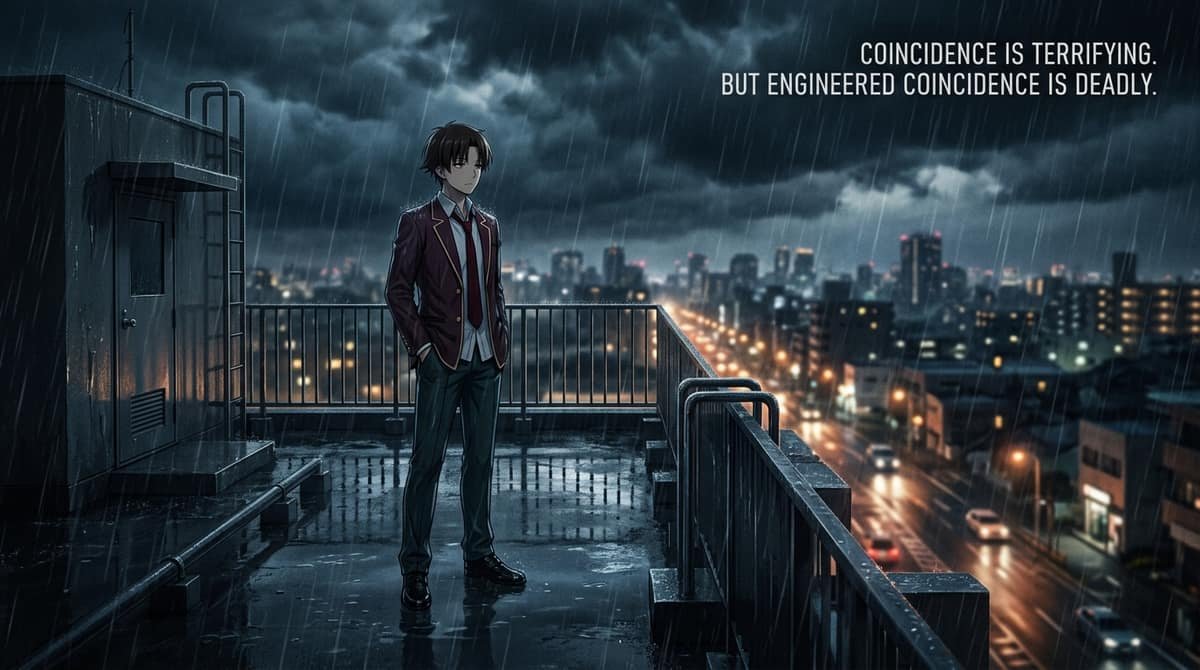
8. “Coincidence is terrifying. But engineered coincidence is deadly.”
The Human Breakdown: In Season 2, Ryuuen thought he was tracking down the mysterious Class D mastermind through brilliant detective work. In reality, Ayanokoji had placed breadcrumbs for weeks, leading Ryuuen directly into the rooftop trap where Class C’s leadership was systematically dismantled.
9. “Pain is just a biological signal. If you don’t fear pain, violence becomes nothing more than a mechanical exercise.”
The Human Breakdown: During the rooftop fight, Ryuuen tried to intimidate Ayanokoji through raw brutality. Ayanokoji didn’t blink, flinch, or show anger. When you remove fear from the equation, bullies and aggressors lose 100% of their psychological power.
10. “Ryuuen… you thought fear was your greatest weapon. But you cannot frighten a man who feels nothing.”
The Human Breakdown: The climax of Volume 7. Ryuuen realized for the first time in his life that he was trapped in a room with a genuine monster whose heart rate never exceeded resting baseline even while throwing knockout punches.
11. “I didn’t step into the light because I wanted recognition. I stepped into the light because you forced my hand.”
The Human Breakdown: Ayanokoji explaining why he had to personally intervene to save Kei Karuizawa. A calculated cost-benefit analysis: revealing a fraction of his physical combat ability was cheaper than losing his most valuable intelligence operative.
12. “Trust is built on mutual vulnerability. But if you give someone genuine trust without collateral, you are simply handing them a knife.”
The Human Breakdown: Ayanokoji’s handling of Kushida and Karuizawa. He never relies on goodwill; he binds people through shared secrets, mutual interest, and protective dependency.
13. “If you want to defeat an enemy who relies on brute force, let them strike until their arms tire out, then break their spirit with a single move.”
The Human Breakdown: Classic martial arts and strategic patience: absorb the initial frenzy, remain unruffled, and deliver the decisive counter when the opponent overextends.
Part 3: The White Room, Equality & Dark Psychology

14. “In the White Room, we learned everything from advanced calculus to martial arts before our tenth birthdays. But they never taught us how to cry. Why would anyone waste time on something that produces zero results?”
The Human Breakdown: A chilling look into Ayanokoji’s conditioning. Tears and grief are evolutionary bonding signals, but in a purely output-oriented facility, emotional expression was treated as biological waste.
15. “People think genius is born. But true superiority is manufactured through merciless repetition, discipline, and the complete elimination of comfort.”
The Human Breakdown: Reflects the White Room’s extreme nurture theory. Anyone can reach elite performance if they are willing to endure a level of psychological and physical pressure that breaks 99% of ordinary humans.
16. “My father wanted to create a human being who could rule Japan from behind the curtain. But I just wanted to buy ice cream and walk in the park.”
The Human Breakdown: The subtle tragedy behind Ayanokoji’s character: immense godlike capability paired with an intensely modest desire for simple, everyday human normalcy.
17. “Sakayanagi, you and I are both anomalies. But while you look down on ordinary people with contempt, I observe them with curiosity.”
The Human Breakdown: Ayanokoji’s chess duel with Arisu Sakayanagi in Season 3. Sakayanagi believes in natural genetic superiority; Ayanokoji studies human behavior like a scientist studying specimens under a lens.
18. “A lie is most effective when it contains 90% truth and only 10% poison.”
The Human Breakdown: Master-class deception psychology: when people can verify nine facts out of ten, they will automatically accept the tenth lethal lie without second-guessing.
19. “If you want to know what someone truly fears, watch what they attack first.”
The Human Breakdown: Psychological projection. When classmates slander others, they are almost always exposing their own deepest insecurities.
20. “The fastest way to gain someone’s loyalty is to rescue them from a crisis that you secretly created.”
The Human Breakdown: The Machiavellian “Hero Syndrome” tactic Ayanokoji utilized with Kei Karuizawa — placing her in high jeopardy, rescuing her, and cementing her absolute emotional devotion.
Part 4: Kei Karuizawa, Horikita & The Human Textbook
21. “Horikita is a sharp knife that doesn’t know how to cut. My job is to sharpen her edges until she can stand on her own without me.”
The Human Breakdown: Ayanokoji’s mentorship of Suzune Horikita. He doesn’t solve her problems directly; he puts her in high-stakes dilemmas so she is forced to mature into a true leader for Class D.
22. “Karuizawa… as long as you remain useful, I will protect you from any storm. But remember: parasites cannot survive without their host.”
The Human Breakdown: The initial transactional dynamic between Ayanokoji and Kei before it evolved into something more complex.
23. “I want to experience what people call ‘love.’ Not because I have romantic feelings, but because love is a textbook chapter I haven’t read yet.”
The Human Breakdown: Ayanokoji’s confession to Kei at the end of Year 1. He views romance as an educational experiment to discover whether his stunted emotions can genuinely awaken.
24. “A leader who carries all the burden alone is not brave; they are reckless. A true leader delegates sacrifice.”
The Human Breakdown: Contrasting Horikita’s early stubborn pride with strategic leadership delegation.
25. “If you corner an enemy completely, they will fight to the death with suicidal courage. Always leave them an apparent exit so they run where you want them to.”
The Human Breakdown: Sun Tzu’s Art of War: never surround a desperate opponent without giving them an illusion of safety that leads into your trap.
26. “I don’t hate my father. Hatred requires emotional investment, and he simply isn’t worth the energy.”
The Human Breakdown: Ultimate cold indifference: opposite of love is not hate, but absolute apathy.
27. “A chess grandmaster doesn’t celebrate when a pawn captures a knight. They planned it twenty moves ago.”
The Human Breakdown: Why Ayanokoji never smiles or celebrates victories: when the outcome is guaranteed by math and psychology, winning is merely routine.
28. “People change when the pain of staying the same becomes greater than the pain of changing.”
The Human Breakdown: Behavioral economics and human habit breaking.
29. “If you want peace, prepare for war. If you want freedom, prepare to sacrifice.”
The Human Breakdown: The Latin axiom Si vis pacem, para bellum applied to high school politics.
30. “In the end, everyone who enters my life becomes a teacher. Some teach me what to do; most teach me what never to do.”
The Human Breakdown: Ayanokoji’s relentless growth mindset: learning from the failures and arrogance of his rivals.
31. “A reputation is what others think of you. Character is what you do in the dark.”
The Human Breakdown: The dichotomy between Hirata’s public golden-boy image and Ayanokoji’s shadow operations.
32. “I am not invincible. I just make fewer mistakes than everyone else.”
The Human Breakdown: Elimination of cognitive biases and emotional errors.
33. “Do not mistake my silence for weakness. Silence is where the plans are drawn.”
The Human Breakdown: The power of active listening in negotiation.
34. “When the student is ready, the teacher appears. When the pawn is ready, the king falls.”
The Human Breakdown: The gradual elevation of Class D to Class A.
35. “I will leave this school one day. And when I do, I will leave behind a class that can defeat even me.”
The Human Breakdown: Ayanokoji’s ultimate hidden ambition: testing whether normal human potential can triumph over the White Room’s manufactured perfection.
♟️ Psychological Strategy: The Dark Triad & Machiavellianism
In psychology, Ayanokoji displays textbook traits of high Machiavellianism — a personality trait characterized by interpersonal manipulation, emotional detachment, and a cynical disregard for conventional morality. Unlike standard anime villains, Ayanokoji exhibits zero sadism or narcissism; his manipulation is purely rational, economical, and focused on maintaining personal autonomy.
The 4 Rules of Ayanokoji’s Social Chess (Real-World Applications)
How can you apply Ayanokoji’s analytical mindset to navigate high-pressure environments, workplace politics, and personal growth? Here are four core principles:
1. Emotional Decoupling: When insulted or provoked, 99% of people react emotionally, losing strategic advantage. Ayanokoji decouples emotion from action, analyzing every problem as an objective equation.
2. Downplaying Capability: Showing off invites jealousy, scrutiny, and sabotage. Under-promising while quietly over-delivering keeps your competitors asleep until it is too late.
3. Understanding Human Incentives: People do not act out of loyalty to you; they act in alignment with their own self-interest. Identify what someone wants (validation, status, safety) and you can predict their behavior with 100% accuracy.
4. The Long Horizon: Reactive people focus on winning the current argument. Ayanokoji focuses on who holds the winning position at the end of the year.
♟️ 15 Ultimate Ayanokoji & COTE Trivia Questions
Test your deep knowledge of ANHS special exams, the White Room, Class D dynamics, and Light Novel lore!
1. What exact score did Ayanokoji intentionally score across all entrance examination subjects?
2. What generation of the experimental White Room facility was Ayanokoji the sole survivor of?
3. What female student was saved by Ayanokoji on the cruise ship and became his most loyal shadow partner and girlfriend?
4. Who was the aggressive, tyrannical leader of Class C who hunted the mastermind in Season 2?
5. What physical handicap and trait distinguishes Class A’s genius leader Arisu Sakayanagi?
6. What is the monthly allowance of private points given to each student in Class A on Day 1 of school?
7. Who was the former Student Council President that Suzune Horikita desperately sought to gain acknowledgment from?
8. What two-faced secret does Kikyo Kushida violently hide from the rest of the school?
9. What is the full Japanese name of the elite high school where COTE takes place?
10. What eccentric high-spec student in Class D refuses to participate and speaks in ancient Shakespearean prose?
11. Who is the homeroom teacher of Class D who blackmailed Ayanokoji into helping the class?
12. What board game did Ayanokoji play against Sakayanagi during the Event Selection Special Exam?
13. Who is Ayanokoji Kiyotaka’s cold, authoritarian political father and founder of the White Room?
14. What is the name of the social outcast study group formed in Class D consisting of Ayanokoji, Keisei, Haruka, and Akito?
15. What martial arts and self-defense background does Ayanokoji possess from the White Room?
Frequently Asked Questions (FAQ) About Ayanokoji Kiyotaka
Q: Does Ayanokoji ever care about anyone genuinely?
A: In Year 1, Ayanokoji is almost entirely Machiavellian. However, through his relationship with Kei Karuizawa and his interactions with the Ayanokoji Group and Manabu Horikita, he exhibits a slow, gradual curiosity about genuine human emotion, though his self-preservation instinct always remains paramount.
Q: Is Ayanokoji considered the smartest anime protagonist?
A: Alongside Light Yagami (Death Note), Lelouch vi Britannia (Code Geass), and Johan Liebert (Monster), Ayanokoji is universally ranked among the top tactical and psychological masterminds in anime history.
Q: What is Ayanokoji’s ultimate goal in Classroom of the Elite?
A: To prove his father wrong. Ayanokoji wants to see if ordinary students from regular backgrounds, when nurtured properly, can surpass the artificial perfection of the White Room.
Final Thoughts: The Mastermind in the Mirror
Ayanokoji Kiyotaka’s philosophy is fascinating not because we should treat others as tools, but because it teaches us how to protect ourselves against manipulation in the real world.
By understanding dark psychology, emotional discipline, and long-term strategic vision, you can maintain your autonomy, guard your mental peace, and ensure that no one else ever treats you like a pawn on their board.

Written by Purosotam
Author & FounderHey there! I’m Purosotam. I’ve been writing, gaming, and exploring anime and web series for a long time while currently pursuing my higher education. I’m fascinated by psychological storytelling, complex characters, and the real-world philosophy hidden behind great dialogue. When I’m not writing or exploring new virtual worlds, you’ll find me at the gym leveling up in real life!