Hachiman Hikigaya’s “I Hate Nice Girls” Speech (Copy & Paste)
“I hate nice girls. Just exchanging greetings with them gets on my mind. Texting each other makes my heart flutter. If I get a call, I’m twitchy all day. But I know that’s just kindness. If someone is nice to me, they’re nice to everyone else too. But I always end up almost forgetting that. If the truth is a cruel mistress, then a lie must be a kind lover. That’s why kindness is a lie. I will never fall for it again.”
In the universe of coming-of-age anime, romantic comedies usually promise sparkling friendships, colorful confessions, and the glorious joy of youth. But in Wataru Watari’s My Teen Romantic Comedy SNAFU (Yahari Ore no Seishun Love Come wa Machigatteiru / Oregairu), Hachiman Hikigaya delivered an uncompromising, brutally honest reality check on teenage social dynamics.
Possessing his iconic “dead-fish eyes” and a fortress of psychological defense mechanisms built from years of rejection and ostracization, Hachiman became the ultimate philosophical voice for introverts, loners, and overthinkers. From his scathing declaration that “Youth is a lie and evil” to his desperate breakdown wishing for “something genuine,” Hachiman’s quotes cut straight to the core of human insecurity. Below is the definitive collection of 35+ of Hachiman’s best quotes, fully explained with human psychological insight.
🥤 Character Lore Fact #1: Max Coffee & The Chiba Pride
Hachiman’s signature drink throughout the series is Max Coffee — an intensely sweet, condensed-milk canned coffee sold primarily in Chiba Prefecture. Hachiman views Max Coffee as a metaphor for his life philosophy: bitter reality can only be endured with unashamed, concentrated sweetness, and enjoying cheap canned coffee alone on a bench is infinitely more peaceful than attending forced social gatherings.
Japanese Dialogue & Romaji: “Ore wa yasashii onna no ko ga kirai da”
🇯🇵 Japanese Kanji / Hiragana (Original Dialogue):
「俺は優しい女の子が嫌いだ。挨拶を交わすだけで気になり、メールをやりとりするだけで心がざわつく。でも、それはただの優しさだ。俺に優しいやつは、他の誰にだって優しいんだ。そんなの当たり前のことなのに、ついうっかり忘れそうになる。真実が残酷なら、嘘はきっと優しいはずだ。だから、優しさは嘘だ。俺はもう二度と引っかからない。」
🗣️ Romaji Pronunciation:
“Ore wa yasashii onna no ko ga kirai da. Aisatsu o kawasu dake de ki ni nari, mēru o yaritori suru dake de kokoro ga zawatsuku. Demo, sore wa tada no yasashisa da. Ore ni yasashii yatsu wa, hoka no dare ni datte yasashii n da. Sonna no atarimae no koto na no ni, tsui ukkari wasuresō ni naru. Shinjitsu ga zankoku nara, uso wa kitto yasashii hazu da. Dakara, yasashisa wa uso da. Ore wa mō nidoto hikkakaranai.”
🌐 Official English Translation:
“I hate nice girls. Just exchanging greetings with them gets on my mind. Texting each other makes my heart flutter. But that’s just kindness. If someone is nice to me, they’re nice to everyone else too. But I always end up almost forgetting that. If truth is a cruel mistress, then a lie must be a kind lover. That’s why kindness is a lie. I will never fall for it again.”
35+ Best Hachiman Hikigaya Quotes (With Human Psychological Explanations)
Part 1: The “Nice Girl” Paradox & Modern Dating Psychology
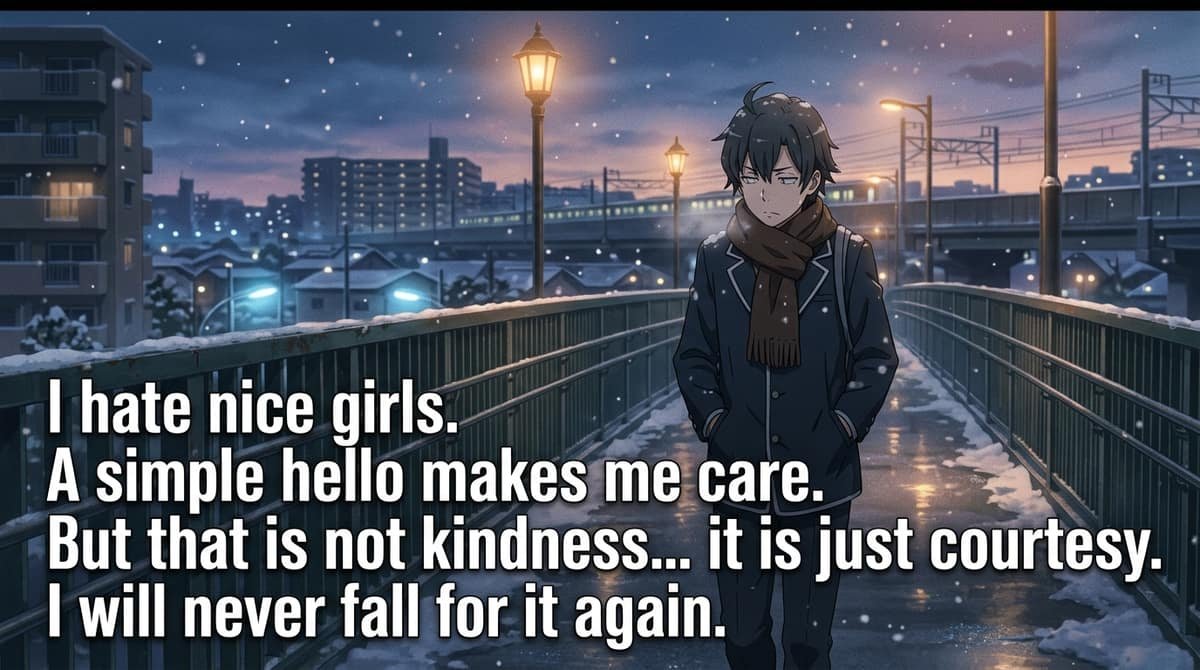
1. “I hate nice girls. Just exchanging greetings with them gets on my mind. Texting each other makes my heart flutter. If I get a call, I’m twitchy all day. But I know that’s just kindness. If someone is nice to me, they’re nice to everyone else too. But I always end up almost forgetting that. If the truth is a cruel mistress, then a lie must be a kind lover. That’s why kindness is a lie. I will never fall for it again.”
The Human Breakdown: Season 1 Episode 5. When Yui Yuigahama acts sweet toward him out of lingering guilt from the car accident on the first day of school, Hachiman hits his emotional brakes. In modern dating, people who have experienced traumatic romantic rejections often develop hyper-vigilance. They mistake basic social politeness for romantic interest, leading to humiliation. Hachiman’s quote is not misogyny; it is a desperate emotional shield to protect a scarred heart from building false hope.
2. “Having expectations only leads to disappointment. If you don’t expect anything from anyone, you can never be betrayed.”
The Human Breakdown: A classic psychological coping mechanism. By keeping his baseline expectation of human behavior at zero, Hachiman removes the possibility of emotional pain. In real life, low expectations prevent heartbreak, but as Hachiman discovers, they also prevent genuine intimacy.
3. “A fake friend will tell you what you want to hear. A real enemy will tell you the truth.”
The Human Breakdown: Hachiman observing classroom cliques like Hayato Hayama’s group. In superficial social circles, people constantly flatter each other to avoid tension, creating fragile relationships built entirely on polite lies.
4. “There are people who are nice to everyone. But that isn’t kindness. Being nice to everyone means you actually care about no one in particular.”
The Human Breakdown: Indiscriminate pleasantness is often an avoidance strategy. When a person refuses to set boundaries or choose sides, their “kindness” is merely a social lubricant to protect their own reputation, not genuine empathy.
5. “If you give someone an inch of warmth, you start craving a mile of fire. That’s why it’s safer to stay in the cold.”
The Human Breakdown: Loneliness is tolerable when you are used to it. The dangerous moment occurs when someone shows you affection, because losing that newfound warmth hurts ten times more than the original solitude.
Part 2: Youth is a Lie & The Deconstruction of School Cliques
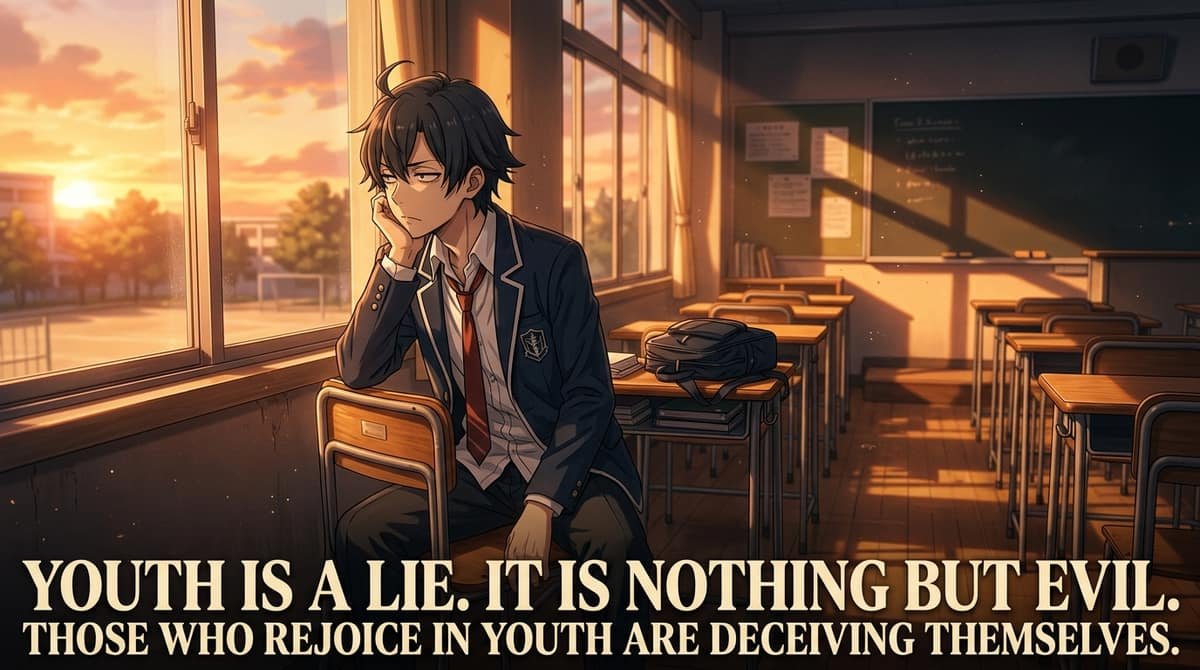
6. “Youth is a lie. It is nothing but evil. Those who rejoice in youth are perpetually deceiving themselves and those around them. They fit everything that surrounds them into a framework of youth.”
The Human Breakdown: The opening essay of Episode 1 that forced teacher Shizuka Hiratsuka to drag Hachiman to the Service Club. Hachiman deconstructs the romanticization of high school. Society tells adolescents that youth is the pinnacle of life, leaving anyone who doesn’t fit into the popular, extroverted mold feeling like an abnormal failure.
7. “If doing nothing is an option, then I will always choose doing nothing. Efficiency is the true measure of intellect.”
The Human Breakdown: Hachiman’s humorous yet deeply practical take on energy conservation. In a world obsessed with performative hustle and pointless meetings, knowing when to step back and conserve mental peace is an underrated life skill.
8. “High school cliques are like miniature feudal kingdoms. The popular kids are royalty, the quiet kids are peasants, and anyone who refuses to play the game is branded a criminal.”
The Human Breakdown: Sociological accuracy at its finest. Hachiman recognizes that school hierarchies are artificial caste systems that vanish the moment you graduate and enter the real world.
9. “A problem isn’t a problem as long as nobody talks about it. That is how adults run society, isn’t it?”
The Human Breakdown: During the Cultural Festival arc, when committee chair Sagami abandons her responsibilities, everyone pretends everything is fine to avoid conflict. Hachiman mocks the corporate culture of sweeping systemic failures under the rug.
10. “Being alone doesn’t make you miserable. What makes you miserable is being surrounded by people who make you feel alone.”
The Human Breakdown: The crucial distinction between solitude and loneliness. Solitude with a book and a coffee is peaceful; sitting at a cafeteria table where you are ignored is agonizing.
Part 3: Social Suicide & The Self-Sacrifice Fallacy
11. “If you want to solve a conflict without anyone getting hurt, you just need someone to become the villain. If everyone hates the same person, the group stays united. And I’m already used to being hated.”
The Human Breakdown: The infamous Cultural Festival rooftop scene. Hachiman publicly humiliates Sagami and makes himself the scapegoat of the entire school to force her back to the stage. He uses “social suicide” as a surgical tool, believing his own reputation has zero value.
12. “You cannot hurt someone who has no pride left to lose.”
The Human Breakdown: Hachiman’s armor. Because he has already hit rock bottom in middle school, insults and ostracization from peers have zero psychological effect on him.
13. “The reason why people hate seeing someone sacrifice themselves isn’t because it’s wrong… it’s because it makes everyone else look like cowards.”
The Human Breakdown: After Hachiman executes a fake confession to save Tobe and Hina’s clique during the Kyoto field trip, Yukino and Yui look at him with deep sorrow. Hachiman thinks they are angry at his methods, failing to realize they are heartbroken that he treats his own heart like disposable garbage.
14. “I’m not a martyr. I just take the shortest path between two points. If stepping on glass gets the job done five minutes faster, I’ll step on the glass.”
The Human Breakdown: Hachiman’s dangerous Machiavellian efficiency. He solves problems structurally, but completely ignores the collateral emotional damage inflicted on the people who care about him.
15. “A scar is proof that you healed. A wound is proof that you’re still fighting.”
The Human Breakdown: Hachiman reflecting on past humiliations, accepting them as the armor that shaped his resilience.
Part 4: The “Genuine” Breakthrough & Vulnerability
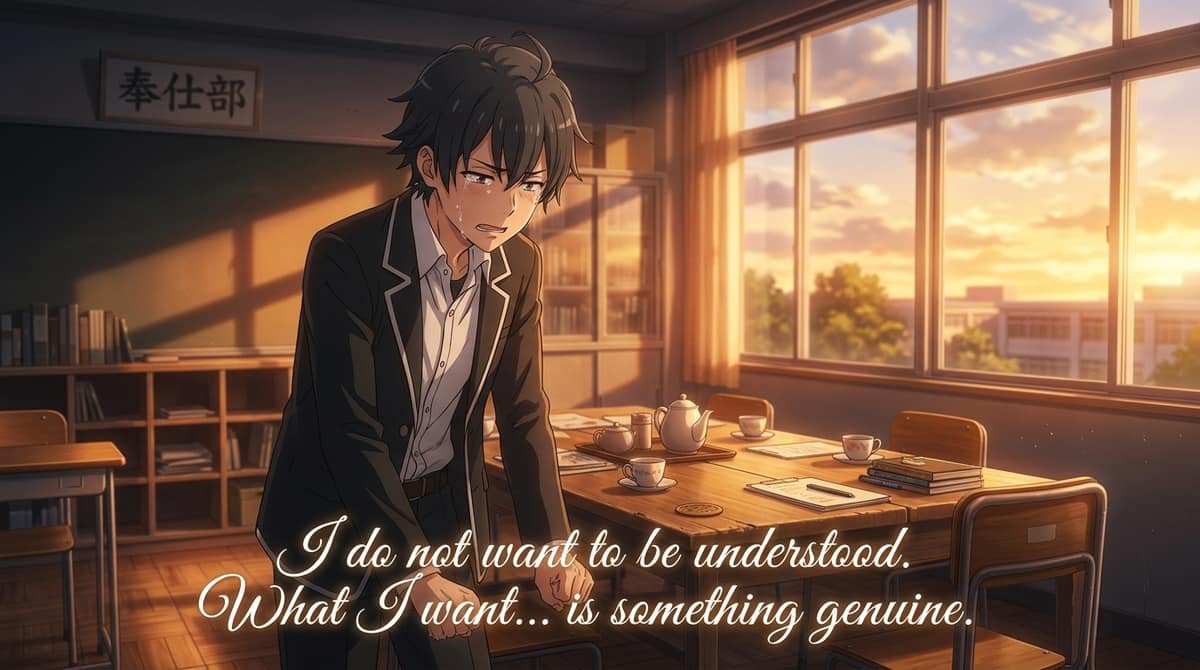
16. “I don’t want words. I don’t want superficial understanding. I don’t care if we hurt each other, argue, or disagree. What I want… is something genuine.”
The Human Breakdown: Season 2 Episode 8. The emotional pinnacle of the entire series. Guided by sensei Shizuka Hiratsuka on the bridge, Hachiman breaks down in tears before Yukino and Yui in the clubroom. He sheds his cynical intellectual armor and admits that beneath all his cynical logic, he desperately desires a bond so real and authentic that it cannot be broken by misunderstandings or polite lies.
17. “If you can’t be honest with yourself, you will never be able to build an honest relationship with anyone else.”
The Human Breakdown: Hachiman realizing that his cynical essays were just as much of a lie as the popular kids’ fake smiles.
18. “A quiet sunset, a cup of warm tea, and two people who don’t need to fill the silence with meaningless words… That is closer to love than any dramatic speech.”
The Human Breakdown: The quiet intimacy of the Service Club room between Hachiman and Yukino.
19. “Changing yourself isn’t growing up. Growing up is learning how to accept who you are while finding a way to live alongside others.”
The Human Breakdown: Hachiman rejecting the idea that introverts must force themselves to become extroverts to be worthy of happiness.
20. “Yukino… you don’t have to carry your family’s expectations on your back alone. If you trip, let me be the excuse you use to stand back up.”
The Human Breakdown: Hachiman’s unconventional, beautifully awkward confession to Yukino during the Prom arc in Season 3.
21. “If you rely on someone, you give them the power to destroy you. But if you never rely on anyone, you destroy yourself.”
The Human Breakdown: The turning point where Hachiman begins to trust Yukino and Yui with his vulnerabilities.
22. “Komachi is the only person in this world who gets a free pass to exploit me, because she’s the only one who actually looks out for my dinner.”
The Human Breakdown: Hachiman’s deep, protective sibling love for his sister Komachi.
23. “People who say ‘money can’t buy happiness’ have clearly never experienced the misery of being broke.”
The Human Breakdown: Hachiman’s hilariously blunt pragmatism.
24. “A bear doesn’t feel lonely living in the mountains. It only feels lonely when you lock it in a zoo with other animals.”
The Human Breakdown: Comparing an introvert’s natural peace with the artificial pressure of forced social environments.
25. “If you have to wear a mask every single day just to fit in with your friends, then those people are not your friends; they are your wardens.”
The Human Breakdown: Identifying toxic social circles where authenticity is punished.
26. “Apologizing to keep the peace when you did nothing wrong is how you teach people that your boundaries don’t matter.”
The Human Breakdown: Assertiveness training: why people-pleasing destroys self-respect.
27. “The hardest person to forgive is always the version of yourself from three years ago.”
The Human Breakdown: Overcoming cringe memories and past awkwardness.
28. “Silence is never empty. It is filled with all the things people are too terrified to say out loud.”
The Human Breakdown: The thick atmosphere of the Service Club during Season 2’s emotional gridlock.
29. “If you want to save someone, you have to be willing to get your own hands dirty. You can’t stand on the shore with clean shoes and expect to pull someone out of the mud.”
The Human Breakdown: Hachiman explaining why real assistance requires personal sacrifice.
30. “A compliment from someone who hates everyone is worth a thousand compliments from someone who likes everyone.”
The Human Breakdown: Why Yukino’s rare words of praise carry immense weight.
31. “I’d rather be hated for who I am than loved for a mask I can’t take off.”
The Human Breakdown: The core foundation of Hachiman’s individualistic creed.
32. “In the end, everyone is the protagonist of their own tragic romantic comedy. The only difference is whether you have the guts to laugh at the ending.”
The Human Breakdown: Embracing life’s absurdity with self-aware humor.
33. “You don’t need a hundred friends. You just need one or two people who know what your silence means.”
The Human Breakdown: Quality of relationships over quantity.
34. “True maturity is realizing that people aren’t thinking about you nearly as much as you think they are. Everyone is too busy worrying about their own hair.”
The Human Breakdown: The Spotlight Effect in cognitive psychology: liberating yourself from the fear of public judgment.
35. “My teen romantic comedy was wrong, twisted, and full of mistakes… but it was mine.”
The Human Breakdown: The bittersweet, heartfelt conclusion of Oregairu Season 3.
🍵 The Service Club Philosophy: Solving Problems at the Root
The motto of the Service Club at Sobu High is inspired by the ancient proverb: “Give a man a fish and you feed him for a day; teach a man to fish and you feed him for a lifetime.” Yukino Yukinoshita believes in empowering people to solve their own problems through self-reliance, while Hachiman historically took the burden onto himself as a lightning rod. Their dynamic represents the eternal struggle between structural rehabilitation and pragmatic crisis intervention.
The Psychology of “Something Genuine” (Why Oregairu Touched a Generation)
What did Hachiman actually mean when he broke down and cried, asking for “something genuine” (本物が欲しい – Honmono ga hoshii)? Here is the psychological breakdown:
1. Beyond Superficial Harmony: In most social groups, people smile, nod, and suppress their true thoughts to preserve the group’s “mood.” Hachiman realized that maintaining a fragile peace through dishonest silence is just a slower form of rot.
2. Accepting the Risk of Pain: A genuine relationship is not one where people never fight; it is a bond where both individuals can reveal their darkest flaws, disagree, and hurt each other without fearing that the relationship will instantly dissolve.
3. Moving Beyond the Loner Armor: Being a cynical loner was safe, but it was also a prison. By asking for something genuine, Hachiman took the ultimate courageous step: allowing himself to desire human connection despite knowing he might get hurt again.
🥀 15 Ultimate Hachiman & Oregairu Trivia Questions
Test your mastery of Sobu High, Max Coffee, the Genuine Speech, and Oregairu lore!
1. What is Hachiman Hikigaya’s favorite sweet canned coffee brand that he drinks constantly in Chiba?
2. What physical eye feature of Hachiman is constantly mocked by his classmates and teacher?
3. What was the name of the white dog belonging to Yui Yuigahama that Hachiman saved on the first day of school?
4. Who was the caring, chain-smoking Japanese language teacher and Service Club advisor at Sobu High?
5. What adorable, hyper-competent younger sister constantly looks after Hachiman and calculates “Komachi points”?
6. What sly, fox-like first-year student became the Student Council President with Hachiman’s assistance?
7. Who is the popular, handsome golden-boy leader of Class 2-F who secretly resents his own inability to change?
8. What androgynous, angelic tennis club captain is Hachiman’s close friend and source of constant internal confusion?
9. What chunibyo light novel writer and gamer is Hachiman’s eccentric classmate at Sobu High?
10. What fake romantic confession did Hachiman execute during the Kyoto field trip to preserve the clique?
11. What manipulative older sister constantly tests Hachiman and Yukino to force them to stop living in denial?
12. What elementary school girl during the summer camp arc did Hachiman help by destroying the artificial friend group?
13. What fictional stuffed character and theme park mascot is Yukino obsessed with?
14. What Japanese animation studio produced Seasons 2 and 3 of Oregairu?
15. What major school event in Season 3 served as the backdrop for Hachiman and Yukino’s mutual confession?
Frequently Asked Questions (FAQ) About Hachiman Hikigaya
Q: Why did Hachiman hate nice girls?
A: Because past rejections made him hyper-sensitive. He recognized that when an extroverted, kind person is friendly, it is simply their baseline personality, not an indicator of romantic affection. Hachiman created this rule to protect himself from falling into false hope.
Q: What does “Something Genuine” mean in Oregairu?
A: It means an authentic, unfiltered human connection that does not rely on pleasant lies, unspoken social contracts, or fear of conflict. It is a bond strong enough to survive raw truth and emotional vulnerability.
Q: Who does Hachiman end up with at the end of Oregairu?
A: In Season 3 (Volume 14 of the Light Novel), Hachiman and Yukino Yukinoshita officially confess their feelings to one another on the bridge, establishing a genuine, mutual relationship while continuing the Service Club with Yui.
Final Thoughts: The Beauty of the Imperfect Journey
Hachiman Hikigaya’s story resonates because almost everyone has experienced moments of alienation, awkwardness, or feeling like an outsider looking in through the classroom window.
While cynical logic can protect your heart from temporary pain, it can also lock you out from the warmth of authentic friendship. True courage is not shutting the world out; it is having the strength to open the door, face the risk of getting hurt, and search for something genuine.

Written by Purosotam
Author & FounderHey there! I’m Purosotam. I’ve been writing, gaming, and exploring anime and web series for a long time while currently pursuing my higher education. I’m fascinated by psychological storytelling, complex characters, and the real-world philosophy hidden behind great dialogue. When I’m not writing or exploring new virtual worlds, you’ll find me at the gym leveling up in real life!