Shinji Ikari’s “I Must Not Run Away” & Acceptance Speech
“I mustn’t run away. I mustn’t run away! I know running away won’t change anything… but staying here hurts so much. I hate myself. But maybe, just maybe, I could learn to love myself. Maybe my life can have greater value. That’s right. I am no more or less than myself. I am me. I want to be here! I want to stay here!”
In 1995, Hideaki Anno and Studio Gainax released Neon Genesis Evangelion (Shin Seiki Evangerion), a revolutionary mecha series that shattered conventional anime tropes to deliver one of the rawest psychological dissections of human loneliness, depression, and existential anxiety ever put on screen.
At the epicenter of this psychological storm stands Shinji Ikari — a traumatized fourteen-year-old thrust into the cockpit of Evangelion Unit-01 by his emotionally distant father, Gendo Ikari. Instead of a fearless hero, Shinji became an avatar for human vulnerability: paralyzed by the Hedgehog’s Dilemma, terrified of rejection, and desperately seeking a reason to exist. Below is the definitive, human-level analytical breakdown of 35+ deep Evangelion quotes, Japanese transcripts, philosophical concepts, and interactive trivia.
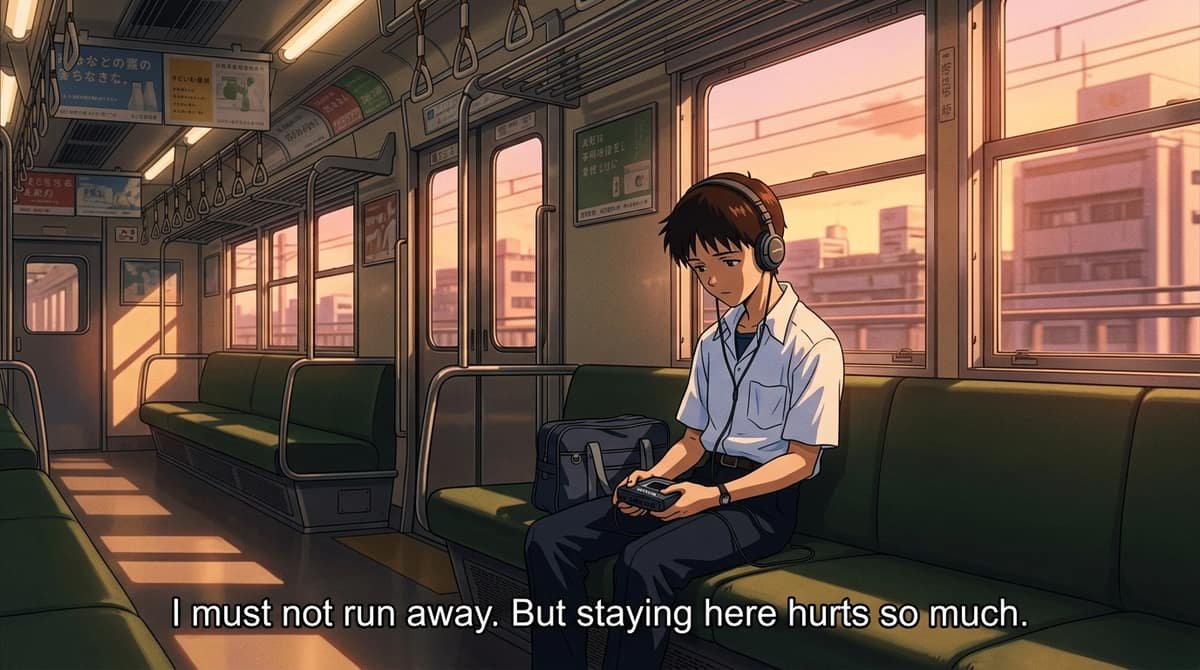
🎧 Lore Fact #1: The SDAT Tape Player & Track 25/26
Throughout the series, Shinji carries a vintage SDAT digital audio tape player given to him by his father. Notice that Shinji continuously loops only Track 25 and Track 26 — representing his emotional stagnation and his inability to move forward. In the Rebuild film series, when Shinji finally matures and makes peace with his trauma, the tape player advances to Track 27 for the first time in history.
Japanese Dialogue & Romaji: “Nigecha dame da, nigecha dame da”
🇯🇵 Japanese Kanji / Hiragana (Original Dialogue):
「逃げちゃダメだ。逃げちゃダメだ!逃げちゃダメだ!…僕は僕が嫌いだ。でも、自分を好きになれるかもしれない。僕はいここにいてもいいんだ!僕は、ここにいたい!」
🗣️ Romaji Pronunciation:
“Nigecha dame da. Nigecha dame da! Nigecha dame da! …Boku wa boku ga kirai da. Demo, jibun o suki ni nareru kamoshirenai. Boku wa koko ni itemo ii n da! Boku wa, koko ni itai!”
🌐 Official English Translation:
“I mustn’t run away. I mustn’t run away! I mustn’t run away! …I hate myself. But maybe, just maybe, I could learn to love myself. It’s okay for me to be here! I want to be here! I want to stay here!”
35+ Deep Evangelion Quotes (With Real-World Psychological Explanations)
Part 1: Shinji Ikari & The Fear of Rejection
1. “I mustn’t run away. I mustn’t run away. I mustn’t run away! I know running away won’t change anything… but staying here hurts so much.”
The Human Breakdown: Episode 1. Standing before the monstrous Angel Sachiel and the towering purple EVA-01, Shinji repeats this mantra to suppress his sheer terror. In psychology, this represents the classic “Approach-Avoidance Conflict.” Shinji wants to escape the unbearable pain of piloting, yet he forces himself forward because fleeing guarantees absolute abandonment by his father. It reflects the struggle of anyone forcing themselves through burnout to earn validation.
2. “I pilot the EVA because people praise me when I do. If I don’t pilot it, nobody needs me. I have no other value.”
The Human Breakdown: Conditional self-worth. Shinji’s identity is entirely outsourced to the approval of authority figures (Gendo and Misato). When a child is only rewarded for utility rather than unconditional love, they grow into adults who believe they must constantly perform or be discarded.
3. “Nobody understands me. But worse than that… nobody even tries.”
The Human Breakdown: The agonizing isolation of adolescent depression. Shinji feels trapped behind an invisible wall where everyone around him is too preoccupied with their own trauma to notice his silent cries for help.
4. “I hate myself. But maybe, just maybe, I could learn to love myself. Maybe my life can have greater value.”
The Human Breakdown: The climax of Episode 26 (The “Congratulations” scene). After wandering through the surreal void of his own subconscious, Shinji realizes that external validation is an illusion; self-acceptance must originate from within.
5. “I thought this was a world without pain… but a world where nothing hurts is a world where nobody exists.”
The Human Breakdown: The rejection of Human Instrumentality in The End of Evangelion. Shinji chooses to return to reality, accepting that genuine human joy cannot exist without the vulnerability of feeling pain.
Part 2: The Hedgehog’s Dilemma & The AT Field
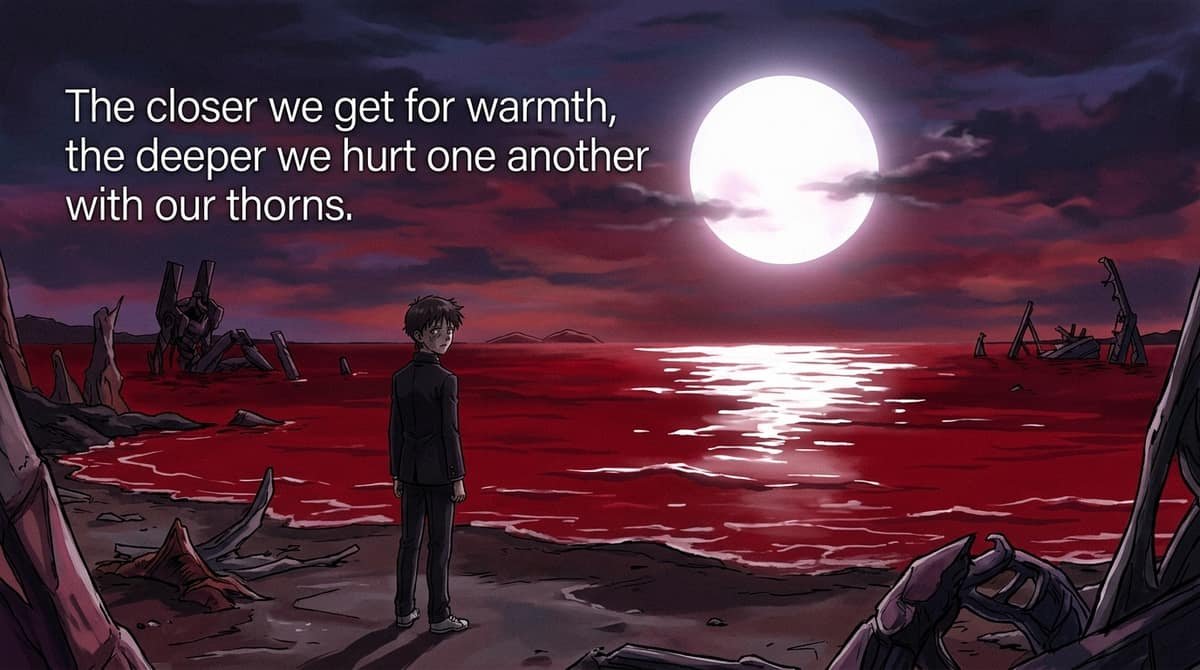
6. “The Hedgehog’s Dilemma: The closer hedgehogs get to each other for warmth on a cold winter night, the deeper they pierce one another with their sharp quills. But if they move away, they freeze in the cold.” — Dr. Ritsuko Akagi
The Human Breakdown: Quoting German philosopher Arthur Schopenhauer. In human relationships, true emotional intimacy requires lowering your defenses. However, being vulnerable guarantees that you will occasionally be hurt by the very person you love. Finding the balance between closeness and boundaries is the central challenge of human maturity.
7. “The Absolute Terror (A.T.) Field is not just a physical barrier against Angels. It is the sacred wall that separates the human soul from others… the barrier that keeps you from dissolving into someone else.” — Kaworu Nagisa
The Human Breakdown: In psychoanalysis, the AT Field is a metaphor for ego boundaries. Without boundaries, individual identity collapses (Instrumentality); with boundaries, loneliness is inevitable.
8. “Sometimes you need a little wishful thinking just to keep on living.” — Misato Katsuragi
The Human Breakdown: Pragmatic survival. Reality is often brutal, and healthy optimism—even when slightly irrational—is sometimes the only fuel that gets humans through catastrophic trauma.
9. “Living alone is peaceful. But it isn’t living. It’s just waiting to die without bothering anyone.” — Misato Katsuragi
The Human Breakdown: Misato confronting Shinji about his emotional withdrawal. Hiding in your room eliminates conflict, but it also eliminates life.
10. “Your truth can be changed simply by the way you accept it. That’s how fragile reality really is.” — Asuka Langley Soryu
The Human Breakdown: Cognitive reappraisal: our suffering is rarely caused by external events, but rather by the narrative filter we construct around those events.
Part 3: Kaworu Nagisa & Fragility of Glass
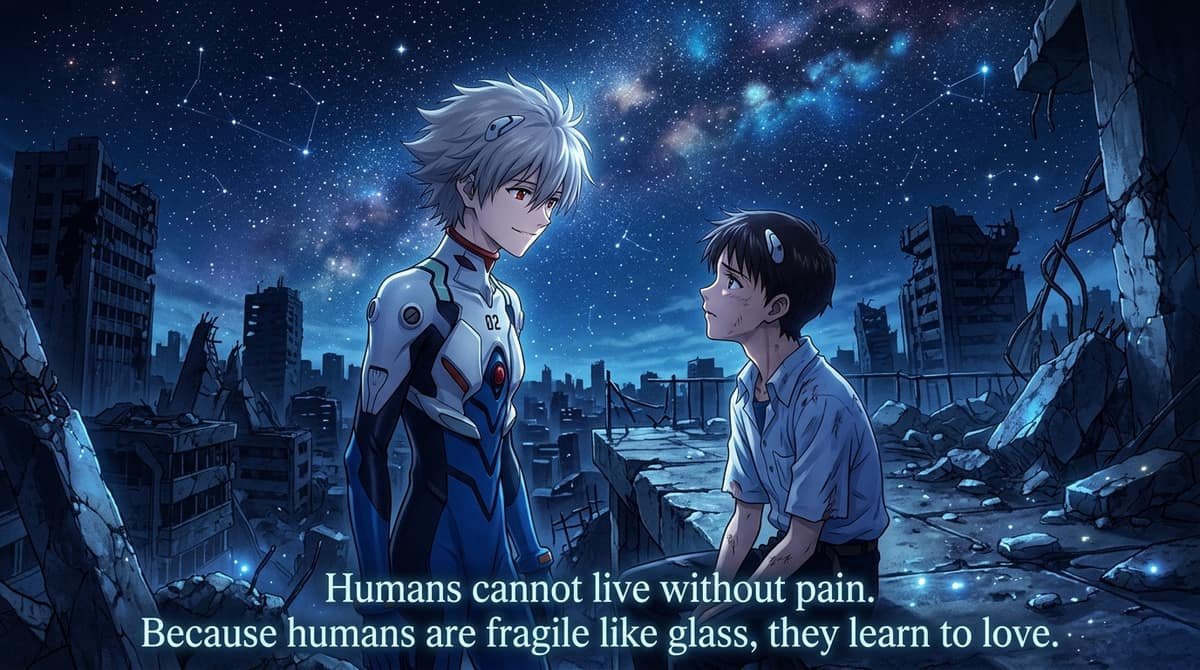
11. “Humans cannot live without pain. Because humans feel pain in their hearts, living can be agonizing. But because they are fragile like glass, they learn how to love.” — Kaworu Nagisa
The Human Breakdown: Episode 24. Kaworu offers Shinji unconditional acceptance without demanding utility in return. He recognizes that human vulnerability is not a flaw, but the prerequisite for empathy.
12. “Music is an art form created by humans. It speaks to the heart without the need for clumsy words. That is why music is man’s greatest achievement.” — Kaworu Nagisa
The Human Breakdown: Shinji and Kaworu bonding over Beethoven’s Ninth Symphony and the piano. Art bypasses cognitive defense mechanisms.
13. “My life and my death are of equal value to me. But for you, Shinji… you have the right to choose the future.” — Kaworu Nagisa
The Human Breakdown: Kaworu’s sacrifice in Terminal Dogma, demonstrating the ultimate act of selfless agency.
14. “You are worthy of grace. You are worthy of love.” — Kaworu Nagisa
The Human Breakdown: The words Shinji had desperately waited his entire life to hear from his father.
15. “Man fears the darkness, and so he scrapes away at the edges of it with fire.” — Rei Ayanami
The Human Breakdown: Rei’s poetic reflection on humanity’s endless struggle against existential dread through technology and science.
Part 4: Asuka, Rei, Gendo & Existential Identity
16. “Look at me! Validate me! If nobody acknowledges me, I will cease to exist!” — Asuka Langley Soryu
The Human Breakdown: Asuka’s psychological breakdown in Episode 22. While Shinji responds to trauma through withdrawal, Asuka responds through aggressive perfectionism and performative superiority. Both are identical coping strategies for fear of abandonment.
17. “I am not a doll. I am myself.” — Rei Ayanami
The Human Breakdown: Rei III crushing Gendo’s glasses and rejecting his control during the Third Impact.
18. “I was afraid of you, Shinji. I was afraid that if I drew close to you, I would only hurt you more, just as I hurt your mother.” — Gendo Ikari
The Human Breakdown: Gendo’s confession in The End of Evangelion. Gendo reveals that his cold cruelty was actually extreme cowardice: he abandoned Shinji because he could not bear the vulnerability of being a father.
19. “Any place can be paradise as long as you have the will to live. After all, you are alive, so you will always have the chance to be happy.” — Yui Ikari
The Human Breakdown: Shinji’s mother summarizing the core thesis of Evangelion: existence precedes essence; meaning is created through living.
20. “If you only look at the world through tears, all you will ever see is rain.” — Misato Katsuragi
The Human Breakdown: The danger of romanticizing depression and emotional helplessness.
21. “I don’t want to die! I don’t want to die! Mama… watch me! I will defeat them all!” — Asuka Langley Soryu
The Human Breakdown: Asuka realizing her mother’s soul resides inside EVA-02, awakening her absolute will to fight.
22. “The worst lie you can tell is the one where you pretend you don’t care.” — Shinji Ikari
The Human Breakdown: Dismantling apathy as a fake defense mechanism.
23. “People cannot understand one another completely. But the effort to try is where humanity is found.” — Ryoji Kaji
The Human Breakdown: Kaji watering his watermelons in the middle of a war zone: finding grounding routines amidst chaos.
24. “If you know pain, you can treat others with kindness. That is what separates humans from beasts.” — Ryoji Kaji
The Human Breakdown: Transforming personal suffering into empathy for others.
25. “I am me. And even if people hate me, I still want to exist as myself.” — Shinji Ikari
The Human Breakdown: The breakthrough of autonomy over conformity.
26. “A mother’s love is the first AT Field a child ever encounters.” — Dr. Naoko Akagi
The Human Breakdown: The psychological origin of security and attachment styles.
27. “We build walls around ourselves not to keep others out, but to see who cares enough to break them down.” — Asuka Langley Soryu
The Human Breakdown: The subconscious tests traumatized individuals administer to potential friends.
28. “To live is to change. If you refuse to change, you are simply a ghost haunting your own body.” — Misato Katsuragi
The Human Breakdown: Stagnation as emotional death.
29. “Even if I am hurt again, I would rather feel pain than feel nothing at all.” — Shinji Ikari
The Human Breakdown: The definitive triumph over nihilism in *End of Evangelion*.
30. “You cannot escape yourself by running to another city. You take your mind with you wherever you go.” — Shinji Ikari
The Human Breakdown: The futility of geographic cures for psychological wounds.
31. “Human beings are lonely creatures because they are separated by their bodies.” — Rei Ayanami
The Human Breakdown: The biological limitation of individual consciousness.
32. “If you never take a step forward, you will never fall. But you will also never walk.” — Misato Katsuragi
The Human Breakdown: Embracing the inevitability of failure as the price of progress.
33. “I wanted someone to hold me, but I was terrified of being touched.” — Shinji Ikari
The Human Breakdown: The core emotional paradox of intimacy anxiety.
34. “Congratulations, Shinji! To all the children… congratulations!” — The Evangelion Cast
The Human Breakdown: The universal therapeutic breakthrough: applauding the simple courage to accept oneself and live.
35. “Goodbye, all of Evangelion.” — Shinji Ikari
The Human Breakdown: The finale of *Evangelion: 3.0+1.0 Thrice Upon a Time*, closing 26 years of psychological struggle and stepping into the real world.
🧠 Psychological Concept: Schopenhauer’s Hedgehog Dilemma
The term Hedgehog’s Dilemma (or Porcupine Dilemma) was coined by Arthur Schopenhauer in his 1851 work Parerga and Paralipomena and later adopted by Sigmund Freud in group psychology. It posits that human intimacy is inherently paradoxical: our innate need for social warmth drives us together, but our individual defense mechanisms and ego boundaries (quills) inevitably cause mutual pain upon close contact.
How to Overcome the Hedgehog’s Dilemma in Real Life
Shinji’s journey in Evangelion offers profound psychological lessons on how to build healthy relationships without running away or retreating into isolation:
1. Differentiate Discomfort from Danger: Feeling awkward or vulnerable when opening up to someone is uncomfortable, but it is not lethal. Shinji often mistook emotional discomfort for life-threatening peril.
2. Build Permeable Boundaries: An AT Field that is 100% impenetrable locks you in a prison of loneliness. An AT Field that is completely dissolved destroys your identity. Healthy boundaries allow love in while filtering out toxicity.
3. Stop Seeking Absolute Validation: Waiting for a parent, boss, or partner to give you permission to feel worthy is a trap. Self-compassion must be granted by yourself.
🩸 15 Ultimate Evangelion Trivia Questions
Test your deep knowledge of NERV, Tokyo-3, Unit-01, Angels, and End of Evangelion lore!
1. What phrase does Shinji Ikari repeatedly chant to himself in the cockpit of EVA-01?
2. What 19th-century German philosopher originally formulated the “Hedgehog’s Dilemma” concept quoted in the anime?
3. What audio tracks on his SDAT cassette player does Shinji continuously loop back and forth?
4. What is the full name of the organization headed by Gendo Ikari tasked with defending humanity against the Angels?
5. Whose human soul is housed within Evangelion Unit-01?
6. What is the designated number of Kaworu Nagisa as the final Angel?
7. What is the name of Misato Katsuragi’s pet warm-water penguin who lives in her apartment?
8. What German phrase does Asuka Langley Soryu famously yell at Shinji when frustrated?
9. What is the oxygenated, translucent liquid that floods the entry plug cockpit allowing pilots to synchronize with EVAs?
10. What supercomputer system composed of three distinct personalities controls NERV’s operations?
11. Who directed the original Neon Genesis Evangelion series?
12. What botanical plant does Ryoji Kaji lovingly tend to in the subterranean GeoFront?
13. What happens to human bodies during the Human Instrumentality Project (Third Impact)?
14. What legendary classical musical piece plays during the climactic Kaworu death scene and Third Impact?
15. What final words does Asuka utter to Shinji on the blood-red beach at the conclusion of The End of Evangelion?
Frequently Asked Questions (FAQ) About Evangelion
Q: What is the main philosophical message of Neon Genesis Evangelion?
A: That running away from reality will never cure loneliness. While human relationships inherently bring the risk of pain (The Hedgehog’s Dilemma), escaping into fantasy or absolute isolation is not living. Meaning is found in accepting yourself, facing reality, and choosing to live alongside others.
Q: Why did Shinji reject Human Instrumentality?
A: Because in Instrumentality, with all human consciousness merged into a painless soup, individuality, love, and genuine connection cease to exist. Shinji realized that pain is the necessary price of having an individual self and being able to touch another person’s hand.
Q: Is Neon Genesis Evangelion considered a psychological masterpiece?
A: Yes. Evangelion is widely studied in university psychology and film courses worldwide for its groundbreaking integration of Freudian psychoanalysis, Schopenhauer’s existential philosophy, and raw depictions of depression.
Final Thoughts: To All the Children, Congratulations
Neon Genesis Evangelion remains timeless because Shinji Ikari is not a distant fictional caricature; he reflects the insecure, frightened child that lives inside all of us.
We all fear being unwanted. We all carry scars from people who were supposed to protect us. But as Shinji learned at the end of his agonizing journey, you do not need to pilot an EVA to deserve love. You are allowed to be here. You are allowed to take up space. And simply waking up each day and refusing to run away from life is your greatest victory.

Written by Purosotam
Author & FounderHey there! I’m Purosotam. I’ve been writing, gaming, and exploring anime and web series for a long time while currently pursuing my higher education. I’m fascinated by psychological storytelling, complex characters, and the real-world philosophy hidden behind great dialogue. When I’m not writing or exploring new virtual worlds, you’ll find me at the gym leveling up in real life!