Itachi’s “Reality is a Mirage” Speech (Copy & Paste)
“People live their lives bound by what they accept as correct and true. That is how they define ‘reality.’ But what does it mean to be ‘correct’ or ‘true’? Merely vague concepts… their ‘reality’ may all be a mirage. Can we consider them to simply be living in their own world, shaped by their beliefs?”
Within the vast philosophical tapestry of Naruto Shippuden, no character embodies the heartbreaking intersection of truth, illusion, and martyrdom quite like Itachi Uchiha. While Madara Uchiha declared his brutal indictment of the world with “Wake up to reality! Nothing ever goes as planned…” and Obito Uchiha succumbed to existential despair in his “I’m in Hell” speech, Itachi approached reality through a chillingly introspective, epistemological lens.
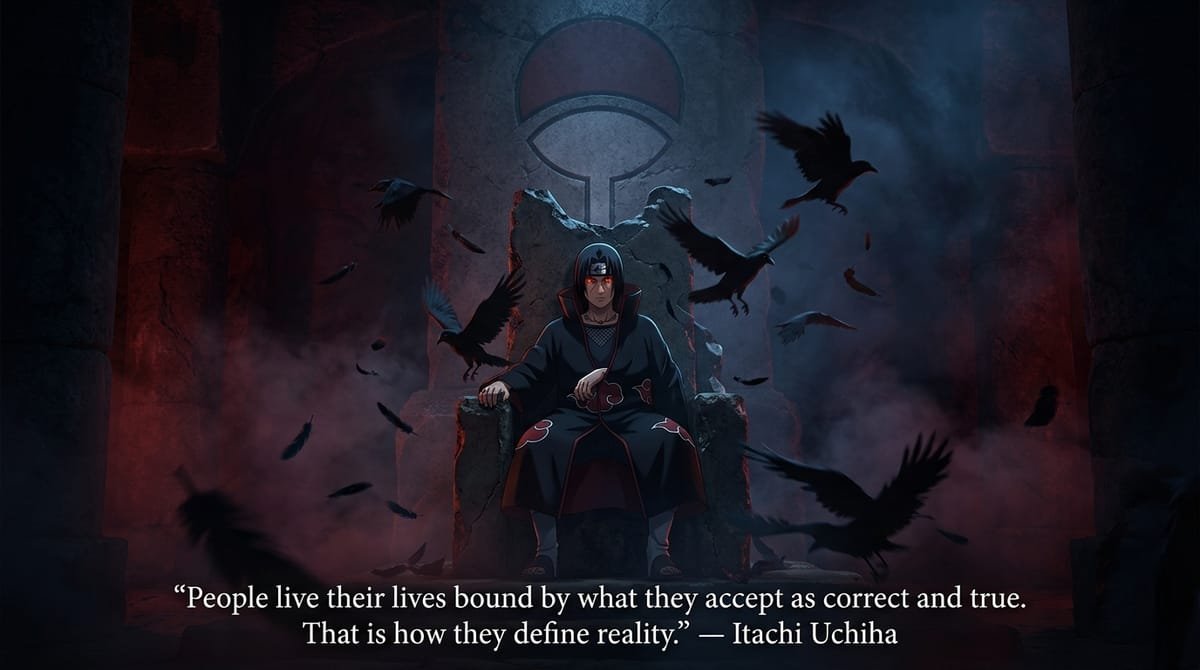
To Itachi, reality was not an unyielding physical cage; it was a fragile psychological construct built entirely out of human preconceptions, confirmation biases, and sensory illusions. When he confronted Sasuke inside the dilapidated Uchiha Clan Hideout, sitting perched upon the stone throne beneath an obsidian halo of crows, he dismantled the very ground his younger brother stood on.
“People live their lives bound by what they accept as correct and true. That is how they define reality.” — Itachi Uchiha
Japanese Transcript, Kanji & Romaji Pronunciation
For anime enthusiasts, cosplayers, and voice-acting admirers, hearing Crispin Freeman (English Dub) or Hideo Ishikawa (Original Japanese) deliver this dialogue is unforgettable. Below is the precise Japanese transcription, kanji breakdown, and English literal translation:
Hito wa daremo ga, onore no chishiki ya ninshiki ni toraware, shibararete ikite iru. Sore o “genjitsu” to yonde na. Daga, chishiki ya ninshiki to wa aimai na mono da. Sono genjitsu ga maboroshi kamoshirenai. Hito wa mina, omoikomi no naka de ikite iru… sō wa kangaerarenai ka?
LITERAL ENGLISH TRANSLATION
“Every human being lives bound by their own knowledge and awareness. They call that ‘reality.’ However, knowledge and awareness are ambiguous things. That reality might just be an illusion. Everyone simply lives inside their own preconceptions… Don’t you think that is possible?”
Part 1: Itachi Quotes on Reality, Truth & Perception Illusions
As the ultimate master of the Tsukuyomi—a genjutsu that alters time, mass, and sensory reality inside the victim’s psyche—Itachi understood better than anyone that what human beings perceive as reality is shockingly pliable. Here are Itachi’s most piercing quotes on human awareness and truth:
Quote #1 • Reality & Mirage Monologue
“People live their lives bound by what they accept as correct and true. That is how they define reality. But what does it mean to be correct or true? Merely vague concepts… their reality may all be a mirage.”
🗣️ Romaji: Hito wa daremo ga, onore no chishiki ya ninshiki ni toraware, shibararete ikite iru…
Philosophical Meaning & Context: The cornerstone of Itachi’s philosophy. Humans live inside echo chambers of their own cognitive validation. What an individual believes to be objective fact is frequently nothing more than subjective convenience.
Speaker: Itachi Uchiha Source: Naruto Shippuden Episode 135
Quote #2 • Advice to Kisame Hoshigaki
“We do not know what kind of people we truly are until the moment before our death. As death comes to embrace you, you will realize what you are. That’s what death is about, don’t you think?”
🗣️ Romaji: Jibun to iu ningen ga donna ningen na no ka wa, shinigawa ni hajimete wakaru mono da…
Philosophical Meaning & Context: Itachi explaining existential identity. You can wear masks, play the villain, or claim righteousness your entire life, but your final choices stripped of ego will reveal your true soul. This quote haunted Kisame until his heroic final sacrifice.
Speaker: Itachi Uchiha Source: Naruto Shippuden Episode 251
Quote #3 • Battle with Kabuto Yakushi
“Those who cannot acknowledge themselves will eventually fail. The moment you lie to yourself about who you are is the moment you seal your own downfall.”
🇯🇵 Kanji: 自分を認めることができない奴は、いずれ失敗する。
🗣️ Romaji: Jibun o mitomeru koto ga dekinai yatsu wa, izure shippai suru.
Philosophical Meaning & Context: Itachi explaining why the Izanami jutsu punishes those who reject their own flaws. Kabuto tried to graft everyone else’s identity onto himself because he hated his own emptiness. Itachi shows that true growth demands brutal self-honesty.
Speaker: Itachi Uchiha Source: Naruto Shippuden Episode 338
Quote #4 • Addressing Nagato’s Chibaku Tensei
“Even the strongest of opponents always has a weakness. Every jutsu has a risk, every shield has a fracture, and every illusion has an exit.”
🇯🇵 Kanji: どんな強敵にも必ず弱点はある。どんな術にも穴はあるものだ。
🗣️ Romaji: Donna kyōteki ni mo kanarazu jakuten wa aru…
Philosophical Meaning & Context: Stoic tactical wisdom. Itachi reminds shinobi that despair is an illusion born of panic. No matter how godlike the opponent (even Edo Nagato’s gravity sphere), analytical composure will always uncover the fatal flaw.
Speaker: Itachi Uchiha Source: Naruto Shippuden Episode 298
Quote #5 • Training with Shisui Uchiha
“Growth occurs when one goes beyond one’s limits. Realizing that is also part of training.”
🇯🇵 Kanji: 限界を超えたときにこそ、人は成長する。それを知ることも修業のうちだ。
🗣️ Romaji: Genkai o koeta toki ni koso, hito wa seichō suru…
Philosophical Meaning & Context: Comfort zones produce stagnation. To elevate your skills or your worldview, you must deliberately put yourself in situations where failure feels imminent.
Speaker: Itachi Uchiha Source: Itachi Shinden: Light and Darkness
Quote #6 • Philosophical Dialogue with Sasuke
“Knowledge and awareness are vague, and perhaps better called illusions. We each live within our own subjective awareness, terrified of the light outside our room.”
🇯🇵 Kanji: 知識や認識とは曖昧なものだ。我々は皆、それぞれの主観の中で生きている。
🗣️ Romaji: Chishiki ya ninshiki to wa aimai na mono da…
Philosophical Meaning & Context: Parallels Plato’s Allegory of the Cave. People become so attached to their small, comfortable interpretations of reality that when someone presents higher truth, they attack the messenger.
Speaker: Itachi Uchiha Source: Naruto Shippuden Episode 136
Quote #7 • Confronting Uchiha Police Force
“You cling to the organization, you cling to the clan, you cling to the name… These things restrict us and limit our capacity. They are despicable things that cast fear into what we do not understand.”
🗣️ Romaji: Soshiki ni shūchaku shi, ichizoku ni shūchaku shi, na ni shūchaku suru…
Philosophical Meaning & Context: A savage critique of tribalism and blind loyalty. The Uchiha elders were so obsessed with clan prestige and resentment that they walked blindly toward civil war. Itachi rejected tribal pride in favor of universal peace.
Speaker: Itachi Uchiha Source: Naruto Shippuden Episode 129
Quote #8 • Edo Tensei Final Soliloquy
“Self-forgiveness is the beginning of true awareness. If you cannot forgive your own weakness, you can never truly see the world as it is.”
🇯🇵 Kanji: 自分を許すことが、本当の自覚の始まりだ。
🗣️ Romaji: Jibun o yurusu koto ga, hontō no jikaku no hajimari da.
Philosophical Meaning & Context: One of Itachi’s most therapeutic quotes. Guilt and shame distort human perception. Until an individual forgives their past mistakes, their worldview will always be warped by self-flagellation.
Speaker: Itachi Uchiha Source: Naruto Shippuden Episode 339
Quote #9 • Teaching Sasuke Shurikenjutsu
“A mirror reflects your image, but it cannot reflect your intent. True sight requires looking into the shadows of your own heart.”
🇯🇵 Kanji: 鏡はお前の姿を映すが、心の内までは映さない。
🗣️ Romaji: Kagami wa omae no sugata o utsusiga…
Philosophical Meaning & Context: Physical appearances deceive. Just because someone looks calm, composed, or villainous on the outside does not reveal the unbearable storm raging within their chest.
Speaker: Itachi Uchiha Source: Naruto Episode 84 (Flashback)
Quote #10 • To Naruto Uzumaki
“No matter how dark and rigid the world appears, there is always a path forward if you refuse to deceive yourself.”
🇯🇵 Kanji: どんなに世界が暗く見えようとも、自分を偽らなければ道は必ずある。
🗣️ Romaji: Donna ni sekai ga kuraku mieyō tomo…
Philosophical Meaning & Context: Unlike Obito who declared the world to be hopeless hell, Itachi believed that honesty and endurance can pierce through even the thickest fog of despair.
Speaker: Itachi Uchiha Source: Naruto Shippuden Episode 299
Part 2: Itachi Quotes to Sasuke – Brotherhood, Love & Eternal Sacrifice
The relationship between Itachi and Sasuke is the emotional spine of the entire Naruto narrative. What seemed for over 300 chapters to be a classic story of brotherly vengeance transformed into one of the most tragic love stories in anime history. Here are Itachi’s most heartbreaking words to Sasuke:
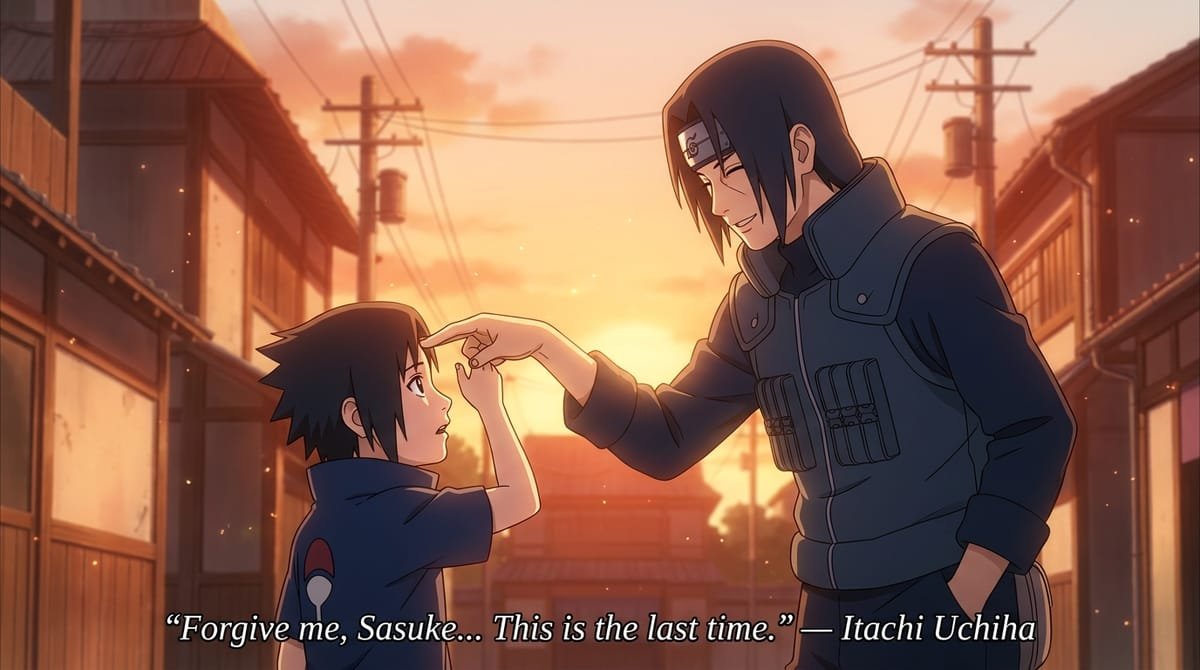
“Forgive me, Sasuke… This is the last time.” — Itachi Uchiha (The Iconic Forehead Poke)
Quote #11 • Final Words Before Death
“Forgive me, Sasuke… This is the last time.”
🇯🇵 Kanji: 許せサスケ…これで最後だ。
🗣️ Romaji: Yuruse Sasuke… kore de saigo da.
Philosophical Meaning & Context: The most iconic line in Itachi’s life. Throughout Sasuke’s childhood, Itachi tapped his forehead saying, ‘Forgive me Sasuke, maybe next time’ to keep him safe at a distance. In death, smiling through blood, Itachi transformed the gesture into an eternal blessing of farewell.
Speaker: Itachi Uchiha Source: Naruto Shippuden Episode 138
Quote #12 • Edo Tensei Final Farewell
“No matter what you decide to do from now on… I will love you always.”
🇯🇵 Kanji: お前がこれからどうなろうと、おれはお前をずっと愛している。
🗣️ Romaji: Omae ga kore kara dō narō to, ore wa omae o zutto aishiteiru.
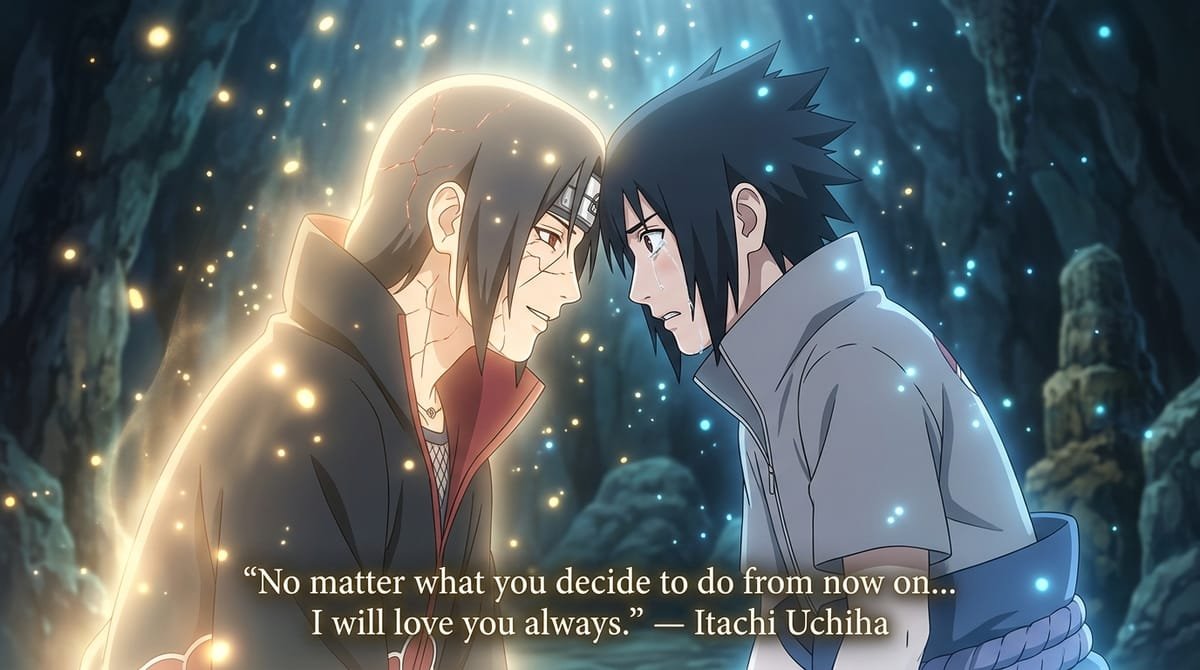
Philosophical Meaning & Context: Pure unconditional love. Itachi doesn’t order Sasuke to protect Konoha or force his own ideals. As his soul ascends back into the afterlife, he presses his forehead against Sasuke’s—treating him at long last as an equal and validating his love regardless of Sasuke’s choices.
Speaker: Itachi Uchiha Source: Naruto Shippuden Episode 339
Quote #13 • The Night of the Uchiha Massacre
“If you want to kill me, hate me, detest me, and survive in an unsightly manner! Run, run and cling to life! And once you possess the same eyes as me, come and face me!”
🗣️ Romaji: Ore o koroshitakuba, urame, nikume, soshite mittomonaku ikinobiru ga ii…
Philosophical Meaning & Context: The calculated cruel mask of the monster. Itachi forced Sasuke to harness the Uchiha’s Curse of Hatred because he knew hatred would give Sasuke the survival drive to awaken the Mangekyo Sharingan and become strong enough to protect himself.
Speaker: Itachi Uchiha Source: Naruto Episode 84 / Shippuden 140
Quote #14 • Childhood Bond in Konoha Forest
“You and I are flesh and blood. I’m always going to be there for you, even if it’s only as an obstacle for you to overcome. Even if you hate me, that’s what big brothers are for.”
🗣️ Romaji: Omae to ore wa yuiitsu muni no kyōdai da…
Philosophical Meaning & Context: Itachi’s tragic definition of brotherhood. He was willing to become the very villain in Sasuke’s hero journey, accepting hatred if it meant guiding his brother toward greatness.
Speaker: Itachi Uchiha Source: Naruto Shippuden Episode 135
Quote #15 • Edo Tensei Confession
“I always lied to you and asked you to forgive me, deliberately keeping you at a distance with these hands… Because I didn’t want you to get caught up in any of this.”
🗣️ Romaji: Ore wa itsumo omae ni uso o tsuki, yuruse to tsukihanashite kita…
Philosophical Meaning & Context: Itachi reflecting on his greatest regret. By shielding Sasuke from the brutal truth of the village’s corruption, he left Sasuke vulnerable to Obito’s manipulation. Over-protection can be as destructive as neglect.
Speaker: Itachi Uchiha Source: Naruto Shippuden Episode 339
Quote #16 • Comforting Infant Sasuke during Nine-Tails Attack
“Don’t cry, Sasuke. Your big brother is here to protect you, no matter what happens.”
🇯🇵 Kanji: 泣くなサスケ…何があっても、兄さんがお前を守ってやるからな。
🗣️ Romaji: Nakuna Sasuke… Nani ga attemo, nī-san ga omae o mamotte yaru kara na.
Philosophical Meaning & Context: At just four years old, holding baby Sasuke as rubble collapsed around Konoha during Kurama’s rampage, Itachi made the foundational vow that dictated every decision of his entire life.
Speaker: Itachi Uchiha Source: Naruto Shippuden Episode 248
Quote #17 • Admitting Failure as an Older Brother
“If I had been open with you from the beginning… if I had looked you in the eyes and told you the truth, maybe you wouldn’t have walked into the darkness alone.”
🇯🇵 Kanji: 初めからお前と真正面から向き合い、同じ目線に立って真実を語り合っていれば…
🗣️ Romaji: Hajime kara omae to masshōmen kara mukiai…
Philosophical Meaning & Context: Humility and remorse. Despite being hailed as a prodigy who thought like a Hokage at age seven, Itachi openly admitted that his prideful secrecy almost destroyed the person he loved most.
Speaker: Itachi Uchiha Source: Naruto Shippuden Episode 339
Quote #18 • Target Practice Flashback
“You have the potential to be even better than me. Never doubt your own talent, Sasuke.”
🇯🇵 Kanji: サスケ、お前にはオレ以上の才能がある。自分の力を疑うな。
🗣️ Romaji: Sasuke, omae ni wa ore ijō no sainō ga aru…
Philosophical Meaning & Context: Unlike their father Fugaku who constantly compared Sasuke to Itachi, Itachi recognized Sasuke’s unique genius and wanted his brother to eclipse him without bearing the weight of clan politics.
Speaker: Itachi Uchiha Source: Naruto Episode 131
Quote #19 • Kabuto Battle Affirmation
“The village does have its dark side and its inconsistencies, but I am still Itachi Uchiha of the Leaf.”
🇯🇵 Kanji: 里に闇や矛盾があろうと、おれは木ノ葉のうちはイタチだ。
🗣️ Romaji: Sato ni yami ya mujun ga arōto, ore wa Konoha no Uchiha Itachi da.
Philosophical Meaning & Context: Definitive declaration of loyalty. Despite being framed as a rogue traitor by Danzo and the council, Itachi did not succumb to resentment. He understood that a nation’s flawed institutions do not negate the innocence of the people living inside it.
Speaker: Itachi Uchiha Source: Naruto Shippuden Episode 338
Quote #20 • Edo Tensei Dissolution
“My life was an illusion, but my love for you was the only real thing in it.”
🇯🇵 Kanji: おれの人生は幻影だったが、お前への愛だけは真実だった。
🗣️ Romaji: Ore no jinsei wa gen’ei datta ga, omae e no ai dake wa shinjitsu datta.
Philosophical Meaning & Context: The poetic climax of Itachi’s character arc. In a world where he had to lie to the Akatsuki, lie to Konoha, lie to his clan, and lie to Sasuke, his fraternal bond was the sole anchor of objective reality.
Speaker: Itachi Uchiha Source: Naruto Shippuden Episode 339
“No matter what you decide to do from now on… I will love you always.” — Itachi Uchiha (Edo Tensei Final Farewell)
Part 3: Itachi Quotes on Shinobi Duty, Sacrifice & The Will of Fire
To understand Itachi, one must understand his conception of the word Shinobi (忍). In Japanese, the kanji Shinobi literally consists of a blade (刃) over a heart (心)—representing the endurance of agonizing emotional pain in silence. Itachi was the supreme manifestation of this virtue:
Quote #21 • Wisdom Passed to Naruto Uzumaki
“It is not that becoming the Hokage makes everyone acknowledge you. It is the one who is acknowledged by everyone that becomes the Hokage. Never forget your friends.”
🗣️ Romaji: Hokage ni natta mono ga mina kara mitomerareru n ja nai…
Philosophical Meaning & Context: Itachi correcting Naruto’s ego during the Fourth Great Ninja War. Naruto was trying to win the war entirely by himself. Itachi warned him that trying to bear the world alone leads to arrogance and failure—the very mistake Itachi made with the Uchiha massacre.
Speaker: Itachi Uchiha Source: Naruto Shippuden Episode 299
Quote #22 • Definition of Shinobi (Shisui’s Legacy)
“Self-sacrifice… A nameless shinobi who protects peace within its shadow. THAT is a true ninja.”
🇯🇵 Kanji: 自己犠牲…名もなき忍として影から平和を護る。それこそが本当の忍者だ。
🗣️ Romaji: Jiko gisei… Na mo naki shinobi to shite kage kara heiwa o mamoru…
Philosophical Meaning & Context: The core philosophy inherited from Shisui Uchiha. True heroes don’t crave monuments, statues, or applause. They accomplish what is necessary in the dark so others can flourish in the daylight.
Speaker: Itachi Uchiha Source: Naruto Shippuden Episode 358
Quote #23 • Warning to Kisame upon First Meeting
“Those who turn their hands against their comrades are sure to die a terrible death. Mark my words.”
🇯🇵 Kanji: 仲間に手をかけるような奴は、ろくな死に方をしない。心して覚えておけ。
🗣️ Romaji: Nakama ni te o kakeru yō na yatsu wa, roku na shinikata o shinai…
Philosophical Meaning & Context: A piercing double-edged confession. Having massacred his own brethren to save the village, Itachi knew the spiritual decay and inevitable agonizing retribution that awaits anyone who kills their own kin.
Speaker: Itachi Uchiha Source: Naruto Shippuden Episode 251
Quote #24 • Conversation with Shisui at Naka River
“Being a shinobi means enduring the unendurable. It means carrying the weight of the world’s sins without uttering a single complaint.”
🇯🇵 Kanji: 忍びとは耐え忍ぶ者のことだ。愚痴をこぼさず、世の業を背負うことだ。
🗣️ Romaji: Shinobi to wa tae shinobu mono no koto da…
Philosophical Meaning & Context: The purest expression of stoicism in anime. True strength is not how loudly you roar; it is how quietly you carry your cross.
“The people of this village, no matter what, were my family. Protecting their peace from within the dark was my duty.”
🇯🇵 Kanji: 里の者たちは皆、おれの家族だった。影の中から平和を守ることがおれの役目だった。
🗣️ Romaji: Sato no monotachi wa mina, ore no kazoku datta…
Philosophical Meaning & Context: Expanding the concept of family beyond genetic bloodlines. Itachi saw every child, civilian, and elder in Konoha as his siblings, making his horrific sacrifice a tragic act of collective salvation.
Speaker: Itachi Uchiha Source: Naruto Shippuden Episode 339
Quote #26 • To Sasuke during Shuriken Training
“True victory is not defeating your enemy; it is walking away with your soul intact.”
🇯🇵 Kanji: 真の勝利とは敵を倒すことではない。己の魂を見失わないことだ。
🗣️ Romaji: Shin no shōri to wa teki o taosu koto dewa nai…
Philosophical Meaning & Context: Winning a battle through savagery or moral compromise turns the victor into a monster. If you destroy your principles to defeat an opponent, you have already lost.
Speaker: Itachi Uchiha Source: Naruto Shippuden Episode 135 Flashback
Quote #27 • Advice to ANBU Black Ops Trainees
“A shinobi without pride is a weapon; a shinobi with excessive pride is a fool. True strength lies in silent resolution.”
🇯🇵 Kanji: 誇りのない忍はただの兵器だが、過剰な誇りを持つ忍は愚か者だ。
🗣️ Romaji: Hokori no nai shinobi wa tada no heiki da ga…
Philosophical Meaning & Context: The middle path of warrior discipline. Pride must never blind a warrior to objective reality, nor should obedience reduce a human being to an unthinking drone.
Speaker: Itachi Uchiha Source: Naruto Shippuden Episode 357
Quote #28 • Tsukuyomi Mental Dialogue
“To survive, we cling to all we know and understand, labeling it ‘reality’. But reality is far more terrifying than the illusions we build to comfort ourselves.”
🗣️ Romaji: Ikiru tame ni hito wa rikai ni shigamitsuki…
Philosophical Meaning & Context: Comforting lies are an emotional narcotic. Facing unfiltered truth requires supreme psychological fortitude.
Speaker: Itachi Uchiha Source: Naruto Shippuden Episode 136
Part 4: Itachi Quotes on War, Hatred & Human Nature
Having witnessed the horrors of the Third Great Ninja War at just four years old, stepping through fields of mutilated corpses, Itachi became a passionate pacifist. His quotes regarding the cycle of vengeance rival the philosophical weight of Pain’s Cycle of Hatred:
Quote #29 • Philosophical Monologue to Naruto
“Selfish desires give birth to war, and hatred is born in order to protect love.”
🇯🇵 Kanji: 身勝手な欲望が戦争を生み、愛を守るために憎しみが生まれる。
🗣️ Romaji: Migatte na yokubō ga sensō o umi, ai o mamoru tame ni nikushimi ga umareru.
Philosophical Meaning & Context: The paradox of hatred. Hatred is rarely born out of pure malice; it is born as an instinctive immune reaction when someone threatens the people or culture you love. Thus, love and hate are two sides of the same coin.
Speaker: Itachi Uchiha Source: Naruto Shippuden Episode 298
Quote #30 • To Sasuke on Uchiha Compound Isolation
“In order to survive, people create walls. But in doing so, they trap themselves inside their own hatred.”
🇯🇵 Kanji: 人は身を守るために壁を作るが、その壁が自らを憎しみの中に閉じ込めることになる。
🗣️ Romaji: Hito wa mi o mamoru tame ni kabe o tsukuru ga…
Philosophical Meaning & Context: Defensive isolationism always breeds paranoia. The Uchiha withdrew to their compound, Konoha cordoned them off, and the resulting mistrust sparked catastrophe.
Speaker: Itachi Uchiha Source: Naruto Shippuden Episode 129
Quote #31 • Rejecting Madara’s Infinite Tsukuyomi
“Peace under an illusion is no peace at all. It is merely a coward’s cemetery.”
🇯🇵 Kanji: 幻の中の平和など、真の平和ではない。それはただの臆病者の墓場だ。
🗣️ Romaji: Maboroshi no naka no heiwa nado, shin no heiwa dewa nai…
Philosophical Meaning & Context: Direct ideological counter to Madara and Obito. Trapping humanity in an eternal dream avoids pain, but it also extinguishes human free will, authentic triumph, and genuine connection.
Speaker: Itachi Uchiha Source: Naruto Shippuden Episode 339
Quote #32 • Reflecting on Sasuke’s Descent
“Hatred is a fire that consumes the vessel carrying it long before it ever touches the enemy.”
🇯🇵 Kanji: 憎しみとは、敵を焼く前にまず己の器を焼き尽くす炎だ。
🗣️ Romaji: Nikushimi to wa, teki o yaku mae ni mazu onore no utsuwa o yakitsukusu honō da.
Philosophical Meaning & Context: Buddha’s teaching echoed in anime. Clinging to resentment is like holding a hot coal with the intent of throwing it at someone else; you are the one who gets burned first.
Speaker: Itachi Uchiha Source: Naruto Shippuden Episode 209 (Flashback)
Quote #33 • Reflections on the Third Great Ninja War
“War is never fought for righteousness; it is fought because two factions each believe their own peace is superior.”
🗣️ Romaji: Seigi no tame ni tatakawareru sensō nado nai…
Philosophical Meaning & Context: A piercing insight into geopolitical conflict. Wars are driven by competing convictions of self-righteousness, each side convinced God or justice is on their banner.
“Pain is inevitable. Suffering is a choice. But losing yourself to revenge is total defeat.”
🇯🇵 Kanji: 痛みは避けられないが、復讐に魂を奪われるのは完全な敗北だ。
🗣️ Romaji: Itami wa sakerarenai ga…
Philosophical Meaning & Context: Grief and trauma occur naturally in life, but dedicating your existence to retribution hands absolute control of your destiny over to the very people who harmed you.
Speaker: Itachi Uchiha Source: Naruto Shippuden Episode 136
Quote #35 • To Kisame Regarding the Rogue Ninja Life
“Those who judge others by the surface of their actions understand nothing of the tragedy that forced their hands.”
🇯🇵 Kanji: 表面的な行動だけで人を裁く者は、その背後にある悲劇を何も理解していない。
🗣️ Romaji: Hyōmenteki na kōdō dake de hito o sabaku mono wa…
Philosophical Meaning & Context: Empathy over condemnation. Society loves to judge outcomes without understanding the impossible circumstances that forced a desperate choice.
Speaker: Itachi Uchiha Source: Naruto Shippuden Episode 251
Part 5: Interactions with the Akatsuki, Kisame & Kabuto
Even while undercover in the most dangerous criminal syndicate in the ninja world, Itachi’s calm intellectualism commanded absolute deference from ruthless killers like Kisame Hoshigaki, Orochimaru, and Kabuto:
Quote #36 • Reassurance to Kisame Hoshigaki
“We are unique human beings, Kisame. We are not fish in a tank. We do not know who we truly are until the end.”
🇯🇵 Kanji: オレたちは人間だ、魚じゃない。自分が何者なのかは、最後まで分からないものさ。
🗣️ Romaji: Ore-tachi wa ningen da, sakana ja nai…
Philosophical Meaning & Context: Kisame saw himself as a shark doomed to eat its comrades. Itachi rejected biological determinism, reminding him that free will exists until your final breath.
Speaker: Itachi Uchiha Source: Naruto Shippuden Episode 251
Quote #37 • Breaking Kabuto’s Dragon Sage Form
“You are obsessed with your own perfection, Kabuto. That is why you are trapped in the Izanami.”
🗣️ Romaji: Omae wa kampeki de aru koto ni shūchaku shite iru…
Philosophical Meaning & Context: Perfectionism is a prison of the ego. The Izanami only releases a target when they accept their mistakes, drop their vanity, and embrace their authentic self.
Speaker: Itachi Uchiha Source: Naruto Shippuden Episode 338
Quote #38 • Explaining the Uchiha Secret Kinjutsu
“The Izanami was created to save clan members from their own hubris. Accept your fate, and the loop will break.”
🗣️ Romaji: Izanami wa, onore o miushinatta dōhō o sukuu tame ni…
Philosophical Meaning & Context: Unlike the Izanagi which rewrites reality to escape death, the Izanami forces you to accept reality to escape madness. It is a jutsu of psychological salvation.
Speaker: Itachi Uchiha Source: Naruto Shippuden Episode 338
Quote #39 • To Sasuke on Over-Engineering Plans
“To understand the world, you must first accept that you cannot control every piece on the board.”
🇯🇵 Kanji: 世界を知るには、盤上の駒すべてを思い通りには動かせないと知ることから始まる。
🗣️ Romaji: Sekai o shiru ni wa, banjō no koma subete o…
Philosophical Meaning & Context: Surrendering the illusion of control. Itachi planned Sasuke’s entire life down to the millisecond, only to watch Sasuke choose vengeance against Konoha anyway. True wisdom recognizes life’s chaotic randomness.
Speaker: Itachi Uchiha Source: Naruto Shippuden Episode 339
Quote #40 • Addressing Danzo Shimura (Flashback)
“The greatest deception is not fooling your enemy; it is convincing yourself that you bear no guilt.”
🇯🇵 Kanji: 最大の欺瞞とは敵を欺くことではない。己に罪はないと思い込むことだ。
🗣️ Romaji: Saidai no giman to wa teki o azamuku koto dewa nai…
Philosophical Meaning & Context: Condemning Danzo’s moral cowardice. Danzo convinced himself that his atrocities were done for the Leaf, washing his hands of moral stain. Itachi, by contrast, carried the full burden of his guilt every second until death.
Speaker: Itachi Uchiha Source: Naruto Shippuden Episode 358
In-Depth Philosophical Breakdown: The Utilitarian Tragedy of Itachi Uchiha
Why do millions of readers in 2026 search for Itachi Uchiha quotes more than almost any other anime figure? Because Itachi stands as the ultimate fictional case study of Moral Utilitarianism pushed to its catastrophic extreme.
1. Utilitarianism vs. Deontology: The Uchiha Massacre
In classical ethical philosophy, Deontology (championed by Immanuel Kant) argues that certain actions—such as killing one’s parents and relatives—are inherently immoral, regardless of the consequences. By contrast, Utilitarianism (Jeremy Bentham and John Stuart Mill) posits that the most moral action is the one that maximizes the greatest good for the greatest number of people.
Itachi was cornered into the ultimate real-world Trolley Problem:
Track A (Inaction): Allow the Uchiha Clan to initiate a bloody coup d’état. The resulting civil war would leave Konoha defenseless, inviting immediate invasion from the Hidden Stone, Cloud, and Mist Villages, plunging the entire continent into the Fourth Great Ninja War with estimated casualties exceeding hundreds of thousands of innocent civilians.
Track B (Action): Pull the lever himself. Annihilate the conspirators within his clan in a single night, spare his innocent younger brother Sasuke, bear the eternal stigma of a monster, and preserve peace for the entire Hidden Leaf.
Itachi chose Track B. He sacrificed his reputation, his family, his happiness, and his soul on the altar of utilitarian duty.
2. Epistemology & Plato’s Allegory of the Cave
When Itachi proclaims, “Their reality may all be a mirage… people live their lives bound by what they accept as correct and true,” he directly channels Plato’s Allegory of the Cave from *The Republic*. In Plato’s allegory, prisoners are chained inside a dark cave, staring at shadows projected on the wall, convinced those shadows represent absolute reality. When one prisoner escapes into the sunlight and returns to explain the truth, the prisoners mock him and attempt to kill him.
Sasuke lived in the cave of vengeance. He mistook the shadow of Itachi’s cruelty for the entire truth. It was only when Itachi removed the chains of deception that Sasuke realized his entire concept of reality had been an illusion manufactured by a loving older brother.
3. The Three Philosophies of Uchiha Realism Compared
The Uchiha clan produced the three greatest philosophical minds in modern shonen. Here is how their views on reality contrast:
Philosopher
Core Reality Quote
View of the World
Ultimate Solution
Madara Uchiha
“Wake up to reality! Nothing ever goes as planned…”
Nihilistic & Broken: Reality is cursed with suffering, loss, and hatred.
Eradicate reality entirely through the Infinite Tsukuyomi.
Obito Uchiha
“I’m in Hell… This world is completely worthless.”
Traumatized & Hopeless: Goodness in this world is a mirage wiped away by tragedy.
Burn the existing reality and construct a fabricated heaven with Rin.
Itachi Uchiha
“People’s reality may all be a mirage… Accept who you are.”
Stoic & Epistemological: Reality is subjective, but enduring duty gives it meaning.
Preserve reality through silent personal sacrifice and unconditional love.
Test your knowledge of Itachi Uchiha’s monologues, jutsu lore, and ideological journey. Tap an option below for instant feedback:
1. In which episode of Naruto Shippuden does Itachi deliver his famous ‘Reality is a Mirage’ speech to Sasuke?
Itachi delivers this legendary speech at the start of their fated showdown inside the Uchiha Clan Hideout in Episode 135 (Manga Chapter 385).
2. What did Itachi whisper into Sasuke’s ear during their childhood forehead poke?
‘Yuruse Sasuke, mata kondo da’ (Forgive me Sasuke, maybe next time) was Itachi’s affectionate trademark line used whenever he had to leave for an ANBU mission.
3. What was Itachi’s primary philosophical reason for casting Izanami on Kabuto Yakushi?
The Izanami is an infinite psychological loop designed specifically to save Uchiha members who lost their way. It forces the target to stop relying on illusions and embrace who they truly are.
4. What is the literal Japanese translation of Itachi’s final words: ‘Ore wa omae o zutto aishiteiru’?
As the Edo Tensei binds dissolved in Episode 339, Itachi pressed his forehead against Sasuke’s and uttered ‘No matter what you decide to do from now on… I will love you always.’
5. Who was Itachi’s best friend and mentor whose eye he used to prevent the coup d’état?
Shisui Uchiha, the master of Kotoamatsukami, entrusted his remaining eye to Itachi before throwing himself into the Naka River to prevent civil war.
6. At what age did Itachi think like a Hokage according to Third Hokage Hiruzen Sarutobi?
Hiruzen noted that having witnessed the battlefield at age 4, Itachi possessed the philosophical wisdom and detachment of a village leader at just 7 years old.
7. Which philosophical ethical dilemma best models Itachi’s decision to execute the Uchiha Clan Massacre?
Itachi faced a classic Utilitarian Trolley Problem: sacrifice his family and clan conspirators to avert a catastrophic continental war that would kill hundreds of thousands.
8. What animal motif was Itachi most famously associated with throughout Naruto Shippuden?
Itachi utilized crow clones (Karasu Bunshin no Jutsu), concealed Shisui’s Sharingan inside a crow stored in Naruto’s stomach, and dissolved into swirling crows.
9. Complete the Itachi quote: ‘Those who cannot acknowledge themselves will eventually…’
Itachi warned Kabuto: ‘Those who cannot acknowledge themselves will eventually fail. The moment you lie to yourself is the moment you seal your downfall.’
10. What vital warning did Itachi give Naruto about becoming Hokage?
Itachi reminded Naruto in Episode 299 that true leadership comes from humility, trust, and peer acknowledgement—not selfish vanity or individual strength.
What the Anime Community on Reddit Thinks (r/Naruto & r/Anime)
Decades after Masashi Kishimoto completed the Naruto manga, discussions surrounding Itachi Uchiha remain among the most fiercely debated on Reddit. Here are the core consensus viewpoints from the community:
“Itachi isn’t a flawless saint, and that’s what makes his character writing legendary. He was a 13-year-old child soldier pressured by corrupt geriatric politicians (Danzo) and an extremist father (Fugaku). He made the most agonizing utilitarian gamble in fiction, carried the guilt without making excuses, and spent his reanimation trying to right his mistakes with Sasuke.”
— Top Comment on r/Naruto Discussion Thread (4,200+ Upvotes)
“His line about reality being a mirage hits differently as an adult. When you’re a kid watching Naruto, you think he’s just sounding edgy. When you grow up and see how media bias, political echo chambers, and personal trauma warp people’s perception of reality, you realize Itachi was dropping graduate-level epistemology in a shonen manga.”
— High-Voted Perspective on r/Anime Philosophy (2,800+ Upvotes)
Explore More Anime Philosophy & Masterpiece Tools
If Itachi’s philosophy of endurance and reality resonates with you, explore our other deep dives and interactive tools across the anime cosmos:
Frequently Asked Questions (FAQ) About Itachi Uchiha
Below are clear answers to the most frequently searched questions regarding Itachi Uchiha’s quotes, motives, and final moments:
What is Itachi’s most famous quote?
Itachi’s most famous philosophical quote is his Reality Speech to Sasuke: “People live their lives bound by what they accept as correct and true. That is how they define reality. But what does it mean to be correct or true? Merely vague concepts… their reality may all be a mirage.” His most iconic emotional line is his dying whisper: “Forgive me, Sasuke… This is the last time.”
Why did Itachi tap Sasuke on the forehead?
The forehead poke (originally used by Shisui Uchiha) was Itachi’s physical expression of love, apology, and protective distance. When Sasuke was young, Itachi poked his forehead with two fingers to gently push him back, keeping him safe from the dark political intrigue of the ANBU. In his final moments, Itachi transferred his eye powers (Amaterasu) through the gesture as a permanent protective seal.
What were Itachi’s final words before his Edo Tensei soul released?
In Naruto Shippuden Episode 339, Itachi’s final words to Sasuke were: “You don’t ever have to forgive me. And no matter what you decide to do from now on… I will love you always” (お前がこれからどうなろうと、おれはお前をずっと愛している).
Is Itachi’s reality speech based on real-world philosophy?
Yes. Itachi’s monologue directly incorporates concepts from Epistemology (the study of knowledge), Subjective Idealism, and Plato’s Allegory of the Cave. It illustrates cognitive confirmation bias—how humans accept only what confirms their existing beliefs and mistake their own narrow perceptions for universal truth.
Was Itachi Uchiha a hero or a villain?
Itachi is best classified as an Anti-Villain and Tragic Martyr. While his massacre of innocent clan members remains an undeniable moral atrocity (which Itachi himself admitted and condemned during his reanimation), his overarching motive was selfless: preventing a world war, protecting the Leaf Village from within the shadows, and ensuring Sasuke’s survival.
Final Thoughts: The Enduring Legacy of Itachi Uchiha
Itachi Uchiha reminds us that greatness is not measured by public acclaim, monuments, or victory parades. It is measured by the depth of what you are willing to endure in silence for those you cherish.
In a world filled with superficial noise, tribal echo chambers, and comforting deceptions, Itachi’s words pierce through the fog: “People live their lives bound by what they accept as correct and true… their reality may all be a mirage.” Question your assumptions, acknowledge your weaknesses, forgive your mistakes, and refuse to let hatred extinguish your humanity.
Purosotam
Anime Philosophy Lead
Lead anime analyst and philosopher at Madara Reality Quotes. Specializing in psychological breakdowns, antihero morality, existential monologues, and the profound intersection between Japanese storytelling and classical Western philosophy.