🇯🇵 Japanese Romaji Transcript
🩸 30+ Categorized Quotes
🧠 Psychological Manipulation Matrix
🎯 15-Question Monster Quiz
Johan Liebert’s “Equality in Death” Speech (Copy & Paste)
“There is nothing special about being born. Not a thing. Most of the universe is just death, nothing more. In this universe of ours, the birth of a new life on some corner of our planet is nothing but a tiny, insignificant flash. Death is a normal thing. So why live? Doctor Tenma… for you, all lives are created equal. That is why you saved me. But you have finally realized it now, haven’t you? Only one thing is truly equal for all… and that is death.”
In the pantheon of psychological thrillers, villains typically conquer through supernatural powers, colossal armies, or overwhelming brute force. But in Naoki Urasawa’s magnum opus Monster, the most terrifying antagonist in anime history wears a tailored European suit, speaks in a calm, melodic whisper, and almost never raises a physical weapon.
Johan Liebert is the personification of absolute nihilism. By peeling back the delicate illusions that hold human society together — morality, family, love, and identity — Johan proved that every human being carries an abyss inside them, waiting for just the right whisper to destroy themselves. Below is the ultimate compendium of 30+ iconic Johan Liebert quotes, Japanese transcripts, psychological breakdowns of 511 Kinderheim, and trivia challenges.
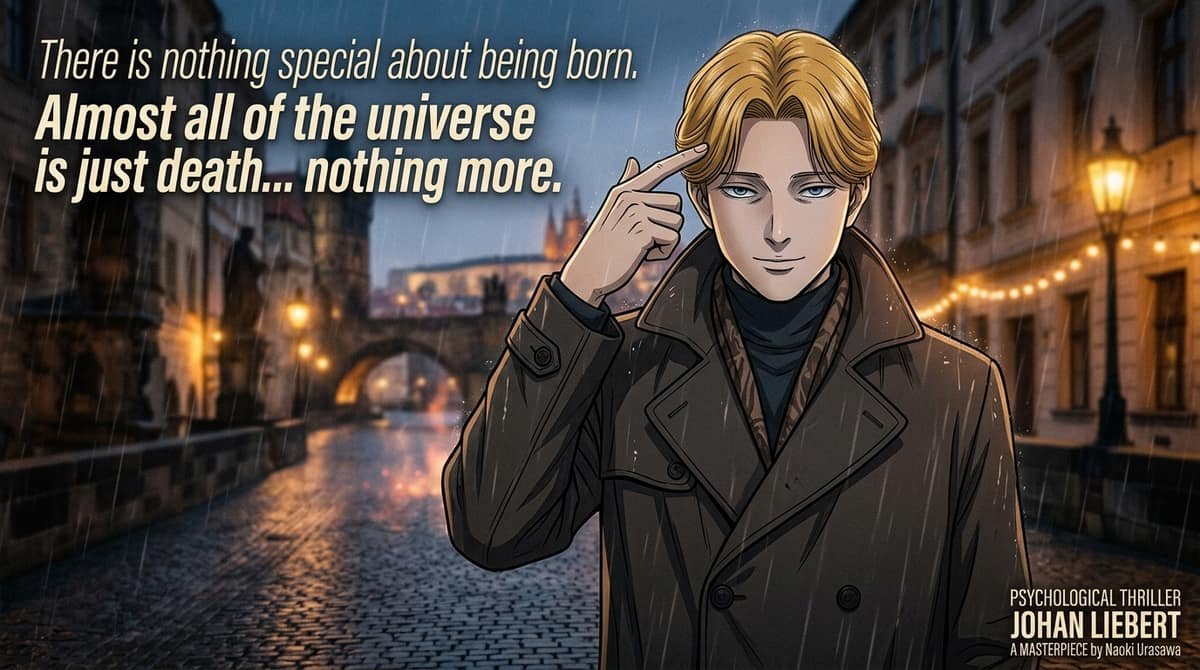
🩸 Psychological Trivia: The Weapon of Zero Force
Across all 74 episodes of Monster, Johan Liebert personally pulls the trigger of a firearm only a handful of times. In almost every single massacre he orchestrates — from the slaughter of 511 Kinderheim staff to the self-destruction of the entire town of Ruhenheim — Johan merely talked to people. He identified their deepest repressed guilt, handed them a weapon, and watched them destroy each other voluntarily.
Japanese Dialogue & Romaji: “Shi dake ga byōdō da”
🇯🇵 Japanese Kanji / Hiragana (Original Dialogue):
「生まれたことなんて、特別でも何でもない。宇宙のほとんどは死そのものだ。テンマ先生…あなたにとって人の命は平等だった。だから僕を助けた。でも、もう気づいたでしょう?すべての人間に平等なのは…死だけだ。」
🗣️ Romaji Pronunciation:
“Umareta koto nante, tokubetsu demo nan demo nai. Uchū no hotondo wa shi sono mono da. Tenma-sensei… anata ni totte hito no inochi wa byōdō datta. Dakara boku o tasuketa. Demo, mō kizuita deshō? Subete no ningen ni byōdō na no wa… shi dake da.”
🌐 English Meaning:
“There is nothing special about being born. Most of the universe is just death. Doctor Tenma… for you, human lives were equal. That’s why you saved me. But you’ve finally realized, haven’t you? The only thing truly equal for all humanity… is death.”
30+ Best Johan Liebert Quotes on Nihilism, Human Nature & Death
Part 1: The Illusion of Equality & The Universality of Death
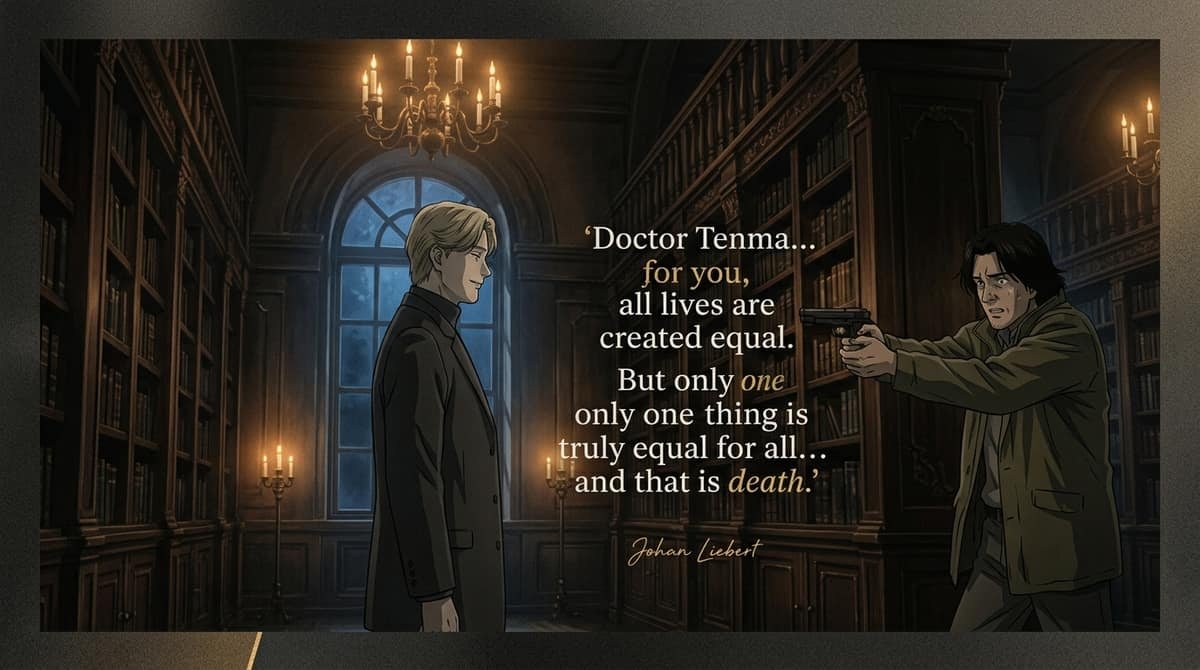
1. “There is nothing special about being born. Not a thing. Most of the universe is just death, nothing more. In this universe of ours, the birth of a new life on some corner of our planet is nothing but a tiny, insignificant flash. Death is a normal thing. So why live?”
Context: Johan’s core philosophical thesis delivered in the Munich University library fire.
2. “Doctor Tenma… for you, all lives are created equal. That is why I came back to life. But you’ve finally realized it, haven’t you? Only one thing is truly equal for all… and that is death.”
Context: Johan confronting Dr. Kenzo Tenma, directly subverting the doctor’s Hippocratic oath.
3. “Tell me, what do you think is the ultimate fear? I thought I’d already reached the darkest of the dark, but then, ahead of me, I beheld an even greater darkness.”
Context: Johan speaking to Detective Richard Brown on the rooftop before orchestrating his suicide.
4. “How weak the human heart is… You can spend decades building a life of virtue, but all it takes is a tiny seed of doubt, and a good man will tear down everything he loves.”
Context: Johan observing the psychological self-destruction of former investigators.
5. “The big secret to breaking the rules is to make it look as though you’re following them.”
Context: Johan explaining how he manipulated underground financial rings and elite German political figures.
6. “Do you know what makes humans kill each other? It isn’t hatred or greed. It’s fear. When you make people terrified of what their neighbor might do, they will strike first every single time.”
Context: Johan’s strategy during the Ruhenheim psychological experiment.
Part 2: 511 Kinderheim, Memory & The Nameless Monster
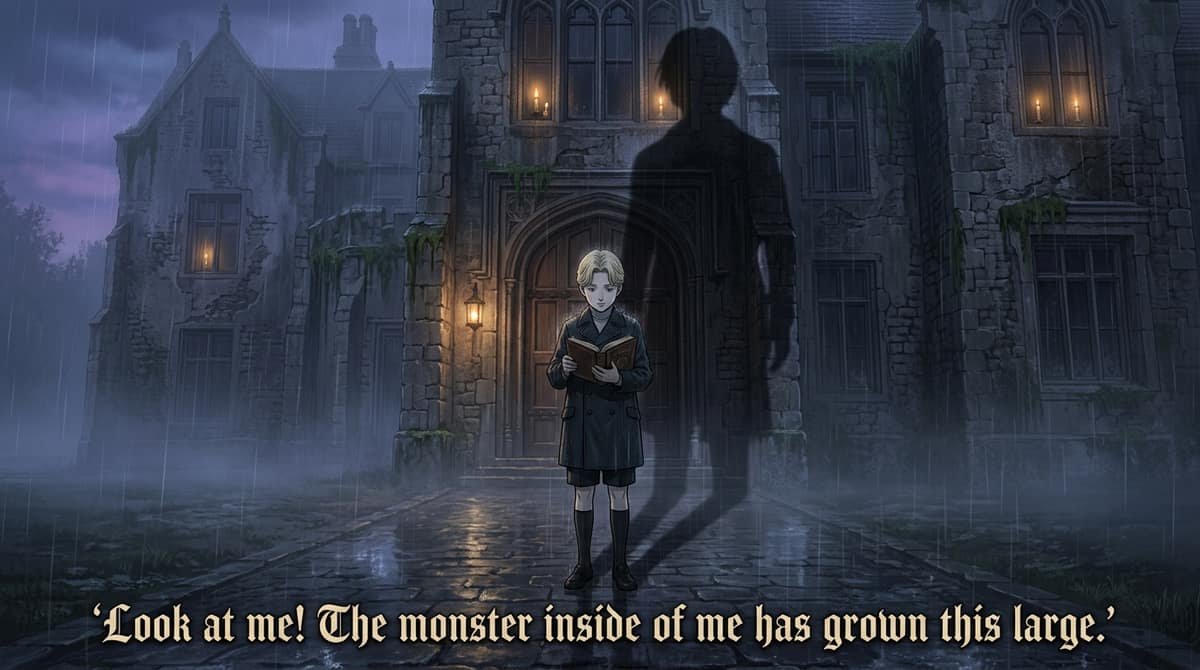
7. “Look at me! Look at me! The monster inside of me has grown this large!”
Context: The iconic refrain taken from Franz Bonaparta’s Czech picture book Obluda, Která Nemá Své Jméno (The Monster Without a Name).
8. “A name? I don’t need a name. When the whole world is gone, who will be left to call me by it anyway?”
Context: Young Johan wandering across the Czech-German border holding hands with Anna.
9. “At 511 Kinderheim, they tried to program us to be emotionless soldiers. But they made one fatal mistake: they thought hatred had to be taught. Hatred is already born inside of us; you only need to remove the fear of consequences.”
Context: Johan describing how 50 children and instructors slaughtered each other at the orphanage.
10. “Memories are fragile things. You can change what a person remembers simply by altering the tone of your voice when telling the story.”
Context: Johan reflecting on how he absorbed his twin sister Anna’s traumatic memories from the Red Rose Mansion as his own.
11. “I am the end. I am the scenery of the end.”
Context: Johan describing his vision of being the last living soul standing in a desolate world where all humanity has erased itself.
12. “If you give a starving man bread, he will thank you. If you give him hope, he will worship you. And once he worships you, you can ask him to kill for you without hesitation.”
Context: Johan manipulating Karl Neumann and elderly billionaire Schuwald.
Part 3: The Ruhenheim Apocalypse & The Final Soliloquy
13. “Shoot me, Tenma. Right here. Right in the forehead. Just like you saved me years ago. End the monster you created.”
Context: Johan pointing to his forehead in the rain of Ruhenheim, daring Dr. Tenma to abandon his morality.
14. “Which one was she trying to save? Was she trying to save me… or was she trying to save my sister? Which one was the unwanted child?”
Context: Johan’s haunting final words from his hospital bed, revealing his core existential trauma regarding his mother’s choice at the Three Frogs building.
15. “People can become anything. A saint, a demon, a king, a beggar… All it takes is the right environment and a gentle push.”
Context: Johan addressing former East German secret police agents.
16. “Can you see it, Doctor? The true scenery of the end? When everyone has slaughtered everyone else, and silence finally returns to the earth.”
Context: Johan overlooking the burning ruins of the Bavarian border town.
17. “Forgiveness is a luxury for the living. The dead don’t care about apologies.”
Context: Johan dismissing the remorse of Franz Bonaparta.
18. “You think your hatred makes you special? Everyone in this town carries the same poison. I only provided the rain; they chose to drown.”
Context: Johan to the terrified survivors of the town massacre.
Part 4: Tenma, Lunge & Nina Fortner: Voices Against the Abyss
19. Dr. Kenzo Tenma: “If you give up on saving a human life because of politics, money, or power, then you stop being a doctor. All lives must be equal.”
Context: Tenma’s foundational moral axiom that sparked the entire narrative.
20. Inspector Heinrich Lunge: “I don’t rely on intuition. Intuition is an emotional trap. I record data, I simulate human behavior, and the truth reveals itself. Johan Liebert is not a ghost… he is a man made of flesh and blood.”
Context: Lunge typing imaginary data into his fingertips during his relentless pursuit.
21. Nina Fortner (Anna Liebert): “I remember now. Johan… you didn’t see the Red Rose Mansion. I was the one who was taken! You took my memories and carried my nightmare as if it were your own!”
Context: Nina uncovering the foundational truth of their childhood trauma.
22. Nina Fortner: “I forgive you, Johan. I won’t let you drag Tenma into the darkness, and I won’t let you die thinking nobody loved you.”
Context: Nina refusing to shoot Johan in Ruhenheim, breaking his nihilistic cycle through unconditional love.
23. Wolfgang Grimmer: “Humans cannot lose their emotions. Even when they torture you, erase your name, and try to turn you into a machine… the tears will still find their way back. Look at me, Tenma… I’m crying for my son!”
Context: Grimmer’s heartbreaking redemption as the Magnificent Steiner.
24. Roberto (Adolf Reinhart): “Johan promised me I would see the scenery of the end. He promised me the ultimate silence.”
Context: Johan’s fanatical right-hand assassin executing his master’s directives.
25. Franz Bonaparta: “I created a monster by trying to manufacture human perfection. But human beings are not canvases to be painted upon. We are creatures that need names, love, and roots.”
Context: Bonaparta’s dying confession in Ruhenheim.
26. Dr. Kenzo Tenma: “No life is born meaningless. Even if the universe is cold and indifferent, we give meaning to each other through kindness.”
Context: Tenma refuting Johan’s nihilistic monologue in the finale.
27. Johan Liebert: “The easiest way to make a monster is to take away a child’s mother.”
Context: Johan explaining the psychological fragmentation of war orphans.
28. Johan Liebert: “People are so eager to believe in a savior that they will follow anyone who smiles and tells them they are safe.”
Context: Johan on the rise of authoritarian charismatic leaders.
29. Johan Liebert: “A perfect crime isn’t leaving no evidence. A perfect crime is making the victim believe it was their own idea.”
Context: Johan’s psychological manipulation methodology.
30. Johan Liebert (The Empty Bed): “When I opened my eyes, the world was still here. But the monster was gone.”
Context: The haunting open-ended final shot of the hospital room in episode 74.
📖 Literary Parallels: Dostoevsky & Raskolnikov
Naoki Urasawa heavily based the dynamic between Dr. Tenma and Johan Liebert on Fyodor Dostoevsky’s classic Crime and Punishment. Johan represents the ultra-rational, amoral “extraordinary man” theory who believes he is above conventional morality, while Dr. Tenma represents Sonia/Razumikhin — the enduring power of human conscience and redemption through suffering.
The 4-Step Manipulation Matrix of Johan Liebert
Psychologists and literary analysts have studied how Johan dismantles human sanity. His methodology follows a precise, four-stage psychological trap:
| Stage | Psychological Tactic | Target Vulnerability | Observed Outcome |
|---|---|---|---|
| 1. The Golden Mirror | Empathic Validation & Charisma | Loneliness & Desire for Recognition | The victim trusts Johan completely and discloses their darkest secrets. |
| 2. The Latent Trauma Exposure | Subtle Socratic Questioning | Repressed Guilt & Past Failures | Johan forces the victim to re-live their most shameful memories. |
| 3. Nihilistic Reframing | Demonstrating the Absurdity of Morals | Faith in Law, Family, or God | The victim realizes their moral framework was an illusion. |
| 4. The Autonomous Collapse | Providing the Means of Destruction | Self-Loathing & Existential Despair | The victim commits murder or suicide without Johan touching them. |
🩸 15 Ultimate Monster & Johan Liebert Trivia Questions
Test your mastery of 511 Kinderheim, Inspector Lunge, Dr. Tenma, and Naoki Urasawa’s masterwork!
1. What East German experimental orphanage was Johan Liebert raised in during the Cold War?
2. What children’s picture book written by Franz Bonaparta served as the psychological blueprint for Johan?
3. What is the real twin sister’s identity of Johan, who lived under the name Nina Fortner?
4. Why did Dr. Kenzo Tenma defy Hospital Director Heinemann’s orders in 1986 Düsseldorf?
5. What bizarre mnemonic habit does BKA Inspector Heinrich Lunge use to store criminal data?
6. What quiet southern German town served as the stage for Johan’s final apocalypse massacre?
7. Who shot Johan in the head in Ruhenheim before Dr. Tenma could pull the trigger?
8. What was the superhero persona adopted by former 511 Kinderheim orphan Wolfgang Grimmer?
9. Who was the elderly blind billionaire in Munich who was reading Latin and French classics with Johan?
10. What alias author pen-names were used by Franz Bonaparta for his dark psychological fairy tales?
11. What gift did Dr. Tenma give to young Johan that Johan kept and later used as a signature clue?
12. How did Hospital Director Heinemann, Dr. Oppenheim, and Dr. Boyer die in 1986?
13. What famous building in Prague was the site of the secret reading seminars for gifted children?
14. What legendary animation studio produced the 74-episode anime adaptation of Monster?
15. What is the final image shown in the final episode of Monster after Dr. Tenma leaves the hospital?
Frequently Asked Questions (FAQ) About Johan Liebert & Monster
Q: What was Johan Liebert’s true goal in Monster?
A: Johan wanted to commit the “Perfect Suicide.” He wanted to erase every trace of his existence, slaughter everyone who knew his name or past, and have Dr. Tenma (the man who gave him life) be the only one to remember him before killing him.
Q: Why did Johan never use physical weapons?
A: Because Johan believed that physical violence is crude. True absolute power is psychological — proving that human beings will willingly tear down their own morals, sanity, and lives when shown the emptiness of existence.
Q: What does the ending of Monster mean?
A: The empty bed leaves Johan’s fate ambiguous. It symbolizes that whether Johan escaped or recovered, the “Monster” inside him — the artificial product of human cruelty and experimentation — has been dismantled because Dr. Tenma and Nina chose unconditional forgiveness over murder.
Final Thoughts: The Lessons of Naoki Urasawa’s Monster
Johan Liebert remains an unmatched villain because he poses a real question: in a universe governed by indifferent death, does human goodness actually matter?
The triumph of Monster is that despite all of Johan’s nihilistic experiments, Dr. Tenma, Nina, and Wolfgang Grimmer proved that empathy, compassion, and the sanctity of life will always outlast the darkness. We are not defined by the cruelty inflicted upon us, but by the love we choose to give back to the world.
Written by Purosotam
Author & Founder
Hey there! I’m Purosotam. I’ve been writing, gaming, and exploring anime and web series for a long time while currently pursuing my higher education. I’m fascinated by psychological storytelling, complex characters, and the real-world philosophy hidden behind great dialogue. When I’m not writing or exploring new virtual worlds, you’ll find me at the gym leveling up in real life!
💬 What the Anime Community on Reddit Thinks (r/MonsterAnime)
Across the global anime community on r/MonsterAnime, thousands of readers and philosophy enthusiasts have debated the real-world meaning behind these monologues. Here is the embedded community thread and the top-voted fan perspectives:
u/DrTenmaScalpel
⬆️ 1.8k upvotes
“Johan Liebert doesn’t need superpowers, Sharingan, or Titan abilities to be the most terrifying antagonist in anime. He only needs a quiet conversation in a dark room to expose the hidden resentment inside an ordinary person’s heart.”
u/NamelessMonsterBook
⬆️ 1.1k upvotes
“The finale of Monster proves that Dr. Tenma won the ideological war. Johan tried to force Tenma to shoot him to prove that ‘lives are not equal,’ and instead, Tenma saved Johan’s life on the operating table a second time—shattering Johan’s nihilism with unconditional medical ethics.”
u/InspectorLunge
⬆️ 690 upvotes
“When Johan points to his forehead and says ‘The only thing humans are equal in is death,’ it sends a colder chill down your spine than any horror movie.”
Naoki Urasawa’s Monster doesn’t get nearly enough credit compared to mainstream shonen, so seeing such a deep psychological breakdown of Johan Liebert and Dr. Tenma here was a treat. “The only thing humans are equal in is death” is chilling.
Monster is an absolute masterclass in psychological tension, David. Tenma proving Johan wrong by saving lives rather than taking them is one of the best endings in fiction.